
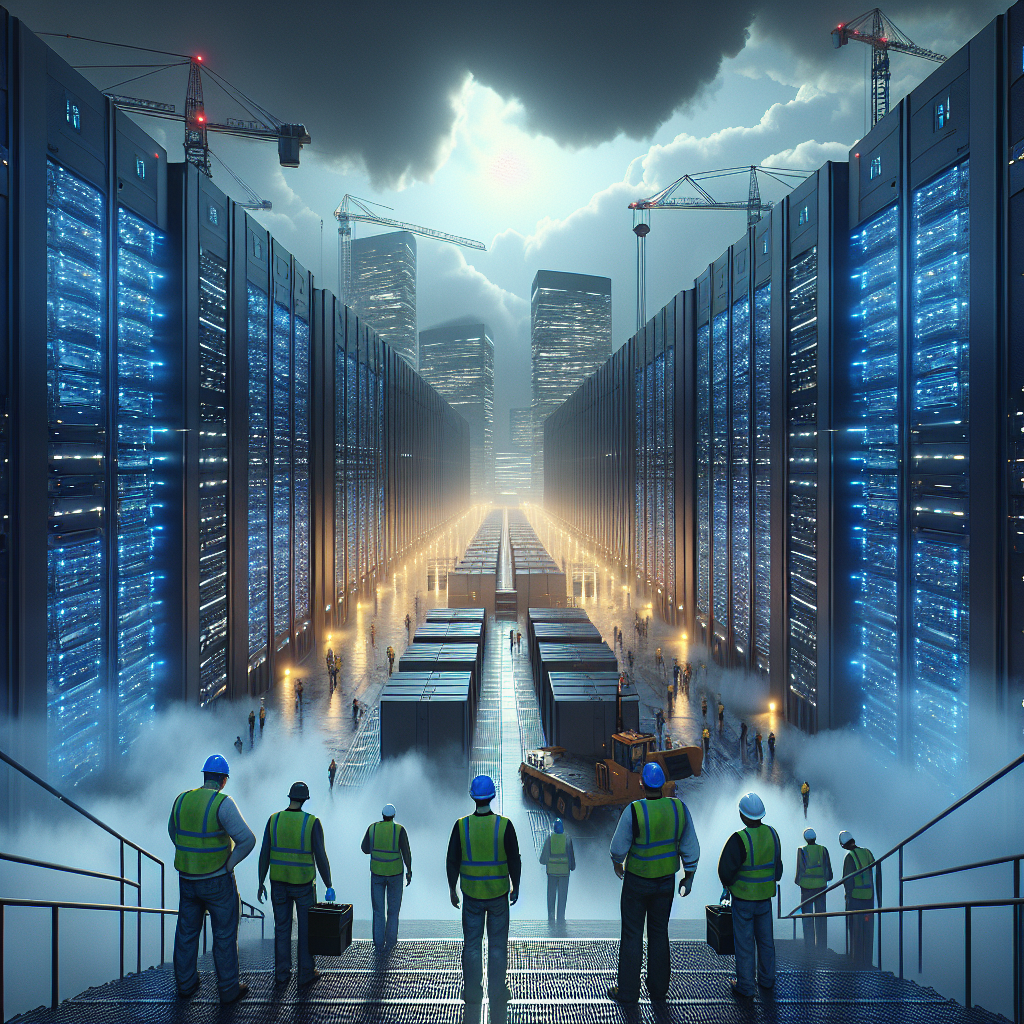
We’ve accidentally built an economy that runs on air conditioning for computers — and I’m not sure whether to be impressed or terrified.
Midnight in Loudoun County
It’s midnight in Loudoun County, Virginia.
Beneath the dim blue glow of distant control screens, the giant cooling fans thrum steady as heartbeats. To most locals, the concrete complexes are just featureless boxes — still, silent, forgettable. But inside, the pulse of the modern economy grows louder with every rack of servers.
I’ve been in these spaces. Not literally Loudoun, but dozens just like it — first as a nervous junior sysadmin learning to rack servers without dropping them, later as an architect designing cloud migrations. There’s something cathedral-like about walking a datacenter floor at 3 AM, where the only sounds are the omnipresent hum of HVAC and the occasional monitoring beep. Thousands of machines processing billions of transactions while humanity sleeps.
We built something that never rests.
What began as infrastructure to connect our lives hs quietly become the engine keeping America’s economic story alive. And that should concern us.
Silicon as Life Support
Early 2025 brought a revelation most people missed: the only thing keeping U.S. GDP growth above flatline wasn’t consumer spending or manufacturing — it was datacenter investment.
Without these tech fortresses, GDP growth for the first half of 2025 would have limped in at a near-recessionary 0.1%.
Lisa Shallet, CIO at Morgan Stanley Wealth Management, puts it bluntly: hyperscaler giants — Microsoft, Google, Amazon, Meta — are driving annual datacenter spending toward $400 billion, outstripping even the great utility, rail, and telecom booms of the past.
Morgan Stanley calculates that datacenter construction alone added one full percentage point to GDP growth in Q1. In Northern Virginia’s “Data Center Alley,” supporting industries — electric utilities, real estate, even catering — have exploded in step.
But here’s what keeps me up at night: this is fundamentally unsustainable architecture.
The Technical Reality Nobody’s Saying Out Loud
Modern AI workloads aren’t just bigger web servers. They’re something new — and scary-hungry:
- ⚡ Training runs that consume megawatt-hours per model. One LLM training session can use enough electricity to power a small town for weeks.
- ⏱️ Inference serving with microsecond latencies at planetary scale. Every ChatGPT query, every real-time AI interaction, hits racks that must respond faster than human perception.
- ♻️ Hardware obsolescence measured in 18–36 months. A $50 million deployment can become e-waste in three years if the next generation of chips is 10× more efficient.
- 🥵 Cooling demands that laugh at traditional HVAC. H100 GPU clusters push power densities that were science fiction five years ago, forcing new electrical substation builds.
Each datacenter carries thousands of racks, eating gigawatts to process billions of ops per second. This isn’t just about cloud storage anymore — it’s about AI that learns, reasons, and reacts in real time.
The Human Element: Maria’s Story
Meet Maria Thompson (not her real name), a single mom from Ashburn. Once she cleaned offices; today she oversees a crew running night shifts at a hyperscale facility.
“My boy just started coding,” she tells me, pride obvious. “When I walk these halls, I see his future — wild, electric, secure.”
Her story repeats nationwide: digital infrastructure creates middle-class jobs that don’t require CS degrees.
But here’s the uncomfortable truth — these jobs exist in the liminal space between human necessity and automation. Lights-out datacenters are coming.
Meanwhile, small-town businesses feel the squeeze: higher power costs, warped housing markets, and less retail spending.
Three Things That Keep Me Up at Night
1. ⚡ The Energy Equation Doesn’t Math
U.S. datacenter demand is projected to spike 50% by 2027, approaching 92 GW — enough to power another United Kingdom. Every new AI capability demands more compute → more power → more infrastructure → more capability… an exponential loop.
2. 🌎 Geographic Concentration = Single Point of Failure
Northern Virginia handles ~70% of global interconnect traffic. That’s not redundancy — that’s a massive single target for geopolitics, disasters, or mundane grid failure.
3. 💸 The Depreciation Time Bomb
Unlike railroads that lasted decades, today’s datacenters must be rebuilt or retrofitted in mere years. Rapid obsolescence + huge energy needs = volatile prosperity. If AI demand or capital slows, GDP’s tech crutch could vanish overnight.
The Part That Gives Me Hope
Buried in the anxiety is something exciting: we’re finally treating digital infrastructure like infrastructure.
For years, tech companies pretended they were just nimble software shops. Now we admit this is utilities-scale investment — and it needs utilities-scale planning:
- Smarter energy policy that treats compute as a first-class grid load
- Regional development beyond “hope tech shows up”
- Skills pipelines connecting workers like Maria to careers, not just jobs
If industry, policymakers, and communities plan together, we can decentralize investment, embed green power, and spread benefits beyond tech elites.
The Question That Matters
Traditional framing asks: Who wins when servers bankroll the economy?
As a techie, I’d ask:
What happens when the marginal cost of intelligence approaches zero — but the infrastructure cost stays astronomical?
Because that’s where we’re headed. AI inference keeps getting cheaper; AI training keeps getting pricier. Knowledge work automates, but the value pools around whoever owns the compute.
That’s not just a tech problem.
It’s a civilization design problem wearing a technology trench coat.
Midnight Reflections
I love that racks of GPUs may cure disease or model climate. I love that kids in Ashburn dream of coding because their mom keeps inference servers alive at night.
But loving something doesn’t mean pretending it’s sustainable.
We’re running an experiment with unclear endpoints, volatile inputs, and a dependency chain that makes 1990s just-in-time manufacturing look robust. If — when — something breaks, it won’t be slow. It’ll be dashboards red, SLAs breached, and GDP falling off a cliff.
Midnight in Loudoun County. The fans hum. The servers process. The cooling systems pump.
But maybe we should ask what happens at dawn.
FAQ
How did datacenters drive U.S. GDP growth in 2025?
Massive hyperscaler investment in AI-ready datacenters contributed over 90% of early-2025 GDP growth, offsetting stagnation elsewhere.
Are there risks to this dependency?
Yes — rapid depreciation, huge energy demand, geographic fragility, and boom-bust investment cycles.
Could the boom go bust?
Absolutely. The “tech trench coat” keeping GDP alive is volatile; when cycles shift, the hit could be sudden and severe.