
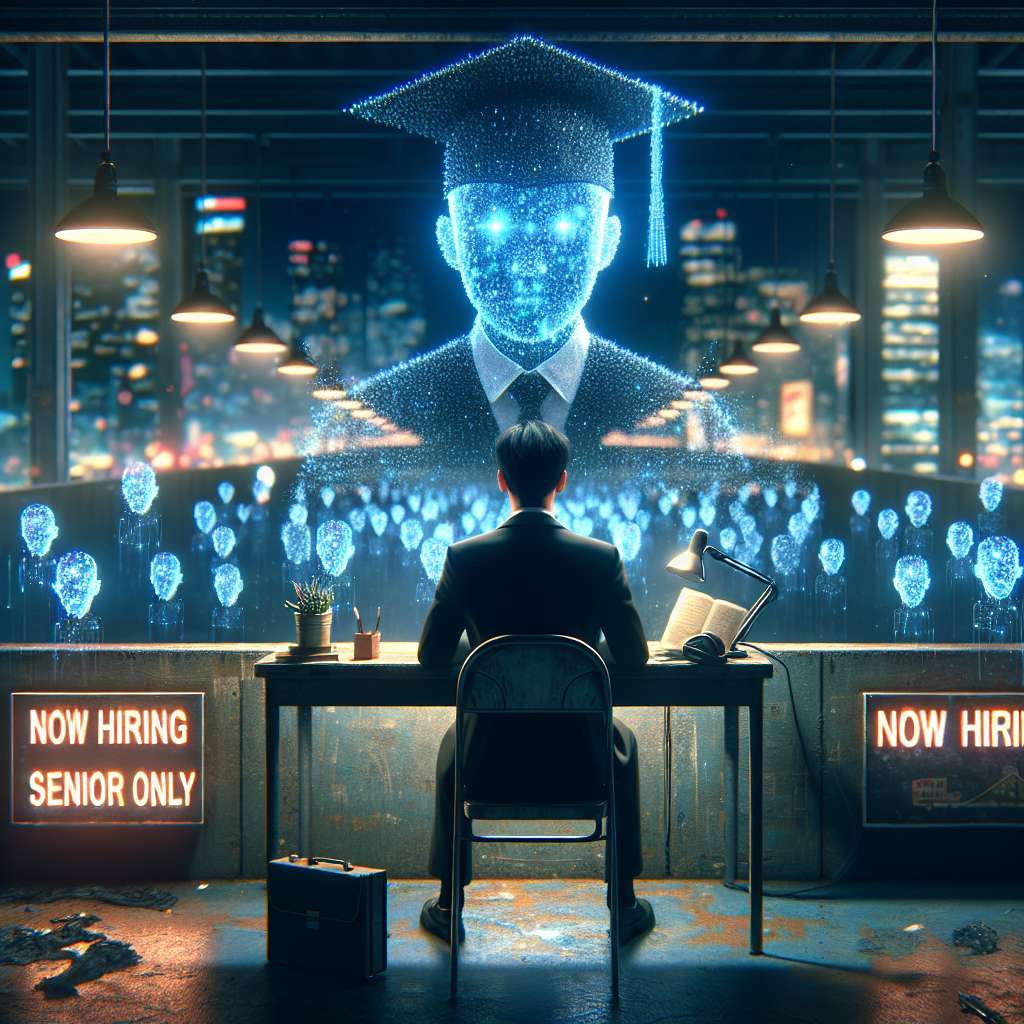
Opening Scene: The Interview That Never Happens
It’s May 2025 in a stuffy student lounge at a top UK university. Samir, a freshly-minted computer science graduate, fixes his tie for the fifth time. He’s rehearsed every possible interview question, his portfolio stacked with coding projects, his LinkedIn buzzing with endorsements. But the emails don’t come. He scrolls a job portal: “Entry-level developer — Not accepting applications.”
Across the globe, stories like Samir’s are unfolding as the tech industry, once a golden ticket for new graduates, slams its doors shut. What happened to the promise that powered a thousand late-night study sessions?
The Big Drop: When Bots Beat Humans
The numbers tell a stark story. Graduate hiring in the UK tech sector has crashed by 46% in the last year[3]. Another 53% drop is expected soon[3]. This isn’t just a dip — it’s a deep freeze. The same trend is echoing across the US: new grad hiring is down 50% compared to pre-pandemic levels, according to SignalFire’s latest tech talent report[1].
The culprit? AI bots. Routine coding, basic data analysis, and entry-level digital tasks — the bread and butter of junior tech roles — are now being handled by sophisticated AI systems[3]. While tech companies still need talent, they’re skipping over newcomers and chasing seasoned pros who can wrangle the machines instead of being replaced by them[1][4].
Why It Matters: A Lost Generation’s Window Narrows
For years, a tech degree meant almost guaranteed employment and a launchpad to innovation. Now, the door is nearly shut for the “lost generation” of new grads. In big tech firms, just 7% of hires are now fresh graduates — down more than 50% from pre-pandemic levels[1]. At startups, the number is even lower[1].
Things are so tough, the unemployment rate for recent grads has jumped 30% since 2022, nearly double the increase for all workers[1]. Even top computer science grads are being left behind; jobs at the likes of Alphabet, Apple, and Tesla have more than halved for new hires[1].
The Anatomy of Disruption: How AI Took Over the Entry-Level Desk
Not long ago, entry-level tech workers handled troubleshooting, quality assurance, and digital admin. Today, AI bots manage routine tasks without coffee breaks or onboarding sessions:
- Coding: Automating repetitive bug fixes and code reviews.
- Data Analysis: Real-time processing of massive datasets, something that used to require entire teams of juniors.
- Digital Maintenance: Bots detect and resolve system hiccups faster than any intern could[3].
Meanwhile, hiring trends have pivoted sharply. Companies prioritize mid- and senior-level experts who can supervise and fine-tune the AI workforce, slashing junior numbers[1][4].
Human Perspective: The Graduate’s Kitchen Table
Back in Samir’s small apartment, his family gathers for dinner. His younger sister, eager to follow in his footsteps, asks, “Is tech still the best bet?” The room falls silent. Samir scrolls through job boards, seeing employers tout “AI-powered teams” and “no junior roles.”
His dad finally says, “You’ll find something. Hard work always wins.” But the old rulebooks don’t apply — and Samir knows it.
Expert Voices & Industry Pulse
Marc Ethier, an analyst following tech hiring trends, explains, “Companies are not just cautious. They’re fundamentally recalibrating, prioritizing experienced talent over training new grads. Layoffs aren’t cyclical — they’re structural. For MBAs, CS grads, anyone hoping to break in, the game has changed”[4].
Stephen Isherwood, joint chief executive of ISE, adds, “It’s a tough market for students and young people. There’s not much churn, and young people are suffering. AI’s impact isn’t just hypothetical anymore. It’s real and it’s here”[3].
Stanford’s labor economists weigh in: “AI’s displacement of entry-level jobs hasn’t yet hit wages for experienced roles, but it has cut career ladders at the base”[3].
Community & Government Response: Adaptation or Apathy?
Governments and universities are scrambling to adapt. Some are pushing for retraining programs and “AI literacy” bootcamps, trying to give grads new skills for surviving in an automated workplace. Initiatives to diversify tech hiring — bringing grads into finance, healthcare, and manufacturing — are gaining steam as CS students send half their job applications to sectors outside traditional tech[2].
Yet, with fewer entry-level ladders, optimism is hard to sell.
What’s Next / Could It Happen Again?
AI’s takeover of junior roles is likely to accelerate. Experts expect hiring for new grads to keep shrinking as automation spreads[3][1]. Companies may eventually face a talent bottleneck at mid-level — a whole generation missing foundational tech experience.
Some advocate for new career pipelines — “hybrid apprenticeship” programs blending human mentorship with machine mastery. Others warn: if entry-level pathways don’t return, tech risks stagnation, with innovation coming only from the same closed loop of senior talent.
Provocative Question:
Who will build the future if no one gets their first break?
FAQ
Q: Why is graduate hiring crashing in the tech industry?
A: Hiring is down up to 46% because AI bots are taking over entry-level jobs, with companies preferring experienced hires for AI supervision[3][1].
Q: What are the long-term effects for tech graduates?
A: Many fresh CS and engineering grads struggle to break in, risking a “lost generation” as career ladders disappear[1].
Q: Is AI the only reason for the decline in grad hiring?
A: While automation is the main driver, shrinking budgets, smaller teams, and transitions to hybrid work also play roles[1][4].
Q: How are governments and industries responding?
A: Retraining programs, AI literacy initiatives, and expanded hiring outside tech are being tried, but impact is limited so far[2].
Q: Which sectors still hire new graduates?
A: Fields like finance, manufacturing, healthcare, and government see increased interest and applications from tech graduates[2].
Q: Could this situation reverse — will entry-level tech jobs return?
A: It’s unlikely in the short term. Experts predict more automation before any rebound, unless new pathways are created[1][3][4].