
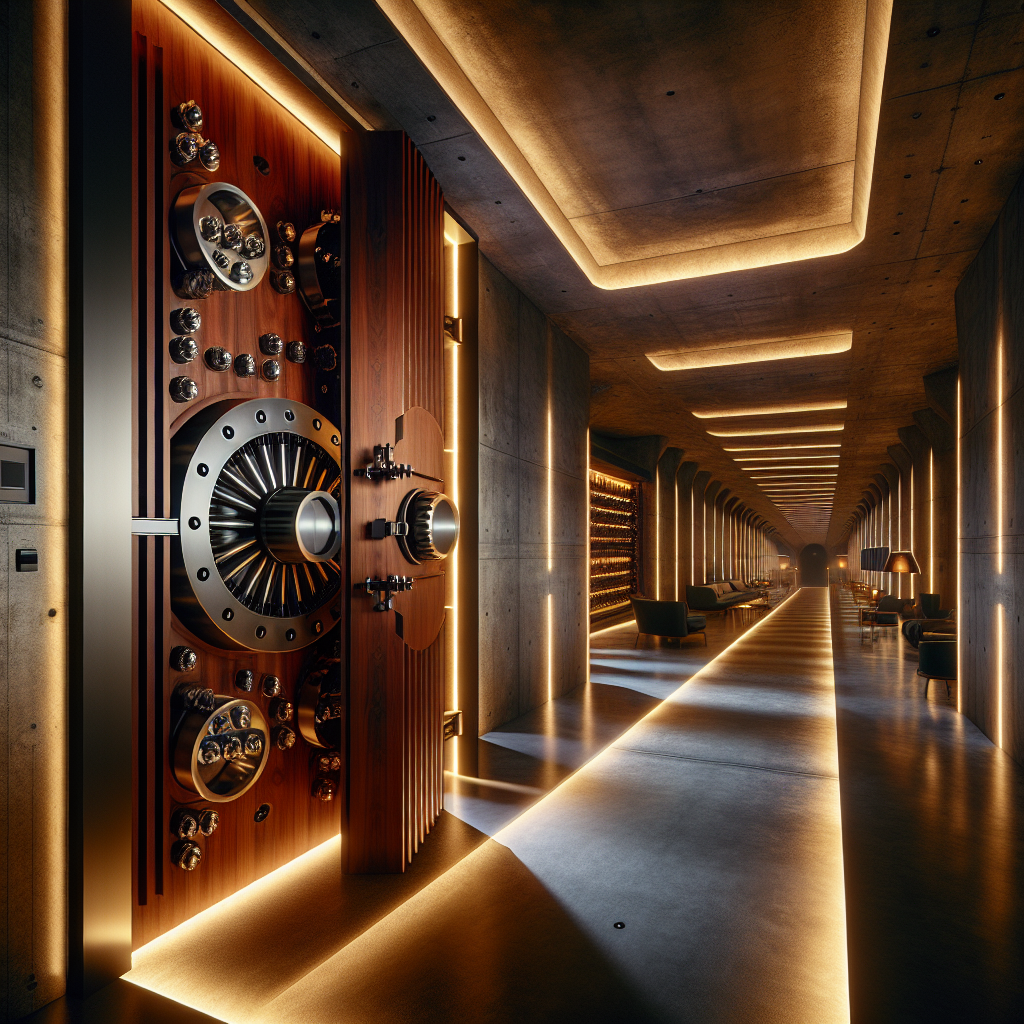
The door looks ordinary enough. Mahogany, perhaps. Hand-carved details. The kind you’d expect in a $20 million brownstone. But press the hidden panel, speak the passphrase, and it swings open to reveal something else entirely: a reinforced steel vault leading to an underground world where the air is filtered, the walls are blast-proof, and the wine cellar doubles as a radiation shelter.
Welcome to the new status symbol of the tech elite.
The Bunker Boom Nobody’s Talking About
Jon Harris has built safe rooms for more people than he can legally discuss. Non-disclosure agreements are standard in his line of work. Sometimes a client wants guitar-themed doors. Other times, rooms concealed behind sliding bookcases. But the requests have evolved beyond Hollywood fantasy.
“It’s kind of like a luxury sports car or an expensive watch,” Harris explains, “but it also saves your life.”
He’s not exaggerating. Mark Zuckerberg reportedly commissioned a bunker in Kauai worth $270 million[2]. Vladimir Putin’s Black Sea complex hides a shelter 160 feet underground with 15-inch concrete walls designed to survive explosions[2]. Saudi princes have ordered 50,000-square-foot bunkers costing $100 million[2]. This isn’t disaster preparation anymore. It’s architectural escapism wrapped in titanium and marketed as prudence.
The supply chain supporting this anxiety economy stretches from discreet contractors installing hidden passages in urban apartments to companies shipping prefabricated fallout shelters across continents[1]. Billboards for bunker companies now outnumber major gas station brands in parts of Texas[1]. What was once the domain of Cold War paranoia has become luxury real estate’s fastest-growing vertical.
When Survival Becomes Performance Art
But here’s where it gets interesting. Douglas Rushkoff, who studies tech culture, has noticed something shifting. The billionaires who spent fortunes on underground palaces have moved on to a new obsession: artificial intelligence and consciousness uploading[1].
“They believe that this technology will exist within their lifetimes,” Rushkoff says. “So instead of just escaping to a new place like an island, they just leave this dimension altogether”[1].
Consider the ages involved. Zuckerberg is 41. Google CEO Sundar Pichai is 53. Elon Musk is 54. Jeff Bezos is 61[1]. These aren’t young futurists banking on distant breakthroughs. They’re middle-aged executives betting their wealth on escaping mortality itself within decades.
Architects in Russia have already designed a Cybertruck-inspired bunker concept: 8,000 square feet, nuclear-resistant, solar and wind powered, housing seven people[2]. Whether Musk commissioned it remains unconfirmed, but the fact that someone designed it speaks volumes about where this market is heading.
The Fracture Line Running Through Society
Imagine you’re a construction worker in rural Texas. You drive past those bunker billboards every morning. You know climate disasters are intensifying. You’ve watched wildfires consume neighborhoods and floods destroy towns. But you can’t afford flood insurance, let alone a reinforced safe room behind a bookcase.
This is the uncomfortable truth buried beneath all that steel and concrete: survival has been privatized. The ultra-wealthy are building individual arks while everyone else relies on communal infrastructure that’s crumbling in real-time[1].
Some billionaires maintain philanthropic fronts. Bill Gates funds global health initiatives. Bezos’s Earth Fund invests in climate solutions[1]. Yet their simultaneous interest in planetary escape plans undermines those gestures. It’s hard to trust someone’s commitment to fixing Earth when they’re simultaneously designing exits from it.
The Illusion of the Sealed Vault
Here’s what the bunker builders don’t advertise: the most elaborate vault door can’t seal off the long tail of a crisis[1]. Pandemics don’t respect property lines. Environmental collapse doesn’t stop at gated communities. The interconnected systems that make modern life possible — supply chains, electrical grids, food production, medical care — can’t be replicated in underground chambers, no matter how luxurious.
Rushkoff suggests there’s a feedback loop at work. “AI is iterative, meaning it’s circular, like a feedback loop,” he notes. “So there’s some chance that the leaders of these industries will have an opportunity through AI to look in the mirror, see their own reflections, and experience the same revulsion the rest of us do”[1].
Perhaps the mirror is already reflecting. Perhaps that’s why they’re building bunkers in the first place.
What Happens When Everyone Builds Their Own Ark?
The bunker boom reveals a philosophical split in how different classes imagine survival. For the wealthy, it’s individualized, monetized, packaged as bespoke lifestyle products[1]. For everyone else, it remains dependent on collective action and public systems.
This fracture has consequences beyond architecture. When society’s most powerful members invest in private escape plans rather than collective solutions, they signal something profound about their faith in our shared future. Or lack thereof.
If the people building tomorrow’s technology don’t believe in tomorrow, should the rest of us?
FAQ
Why are tech billionaires building doomsday bunkers?
Tech billionaires are investing in luxury survival bunkers as insurance against catastrophic events like pandemics, climate disasters, or social collapse. These structures have evolved from basic shelters into sophisticated underground estates worth hundreds of millions of dollars, reflecting both genuine anxiety about global instability and the commodification of survival as a status symbol.
How much do billionaire bunkers cost?
Billionaire bunker costs range dramatically based on size and features. Standard luxury bunkers start around several million dollars, while elaborate compounds reach $100-270 million. Mark Zuckerberg’s Kauai bunker reportedly cost $270 million, while some Saudi clients have commissioned 50,000-square-foot shelters costing $100 million.
What features do luxury doomsday bunkers include?
High-end survival bunkers feature blast-proof walls, air filtration systems, hidden entrances behind bookcases or custom doors, wine cellars, living quarters, and reinforced concrete construction. Some include solar and wind power, extensive food storage, and amenities matching luxury estates. The emphasis is on maintaining comfort during extended isolation.
Are billionaire bunkers effective for survival?
While bunkers provide physical protection from immediate threats, their effectiveness for long-term survival is debatable. Experts note that bunkers cannot seal off the interconnected systems essential for modern life — supply chains, infrastructure, social bonds, and public services. True survival during major catastrophes requires collective solutions rather than individual fortresses.
What is consciousness uploading and why do tech billionaires believe in it?
Consciousness uploading refers to theoretical technology that would transfer human consciousness to digital form, effectively achieving immortality. Some tech billionaires believe this will become possible within their lifetimes, representing an ultimate escape from physical reality. This has become a growing focus among tech elite previously focused on physical bunkers.