
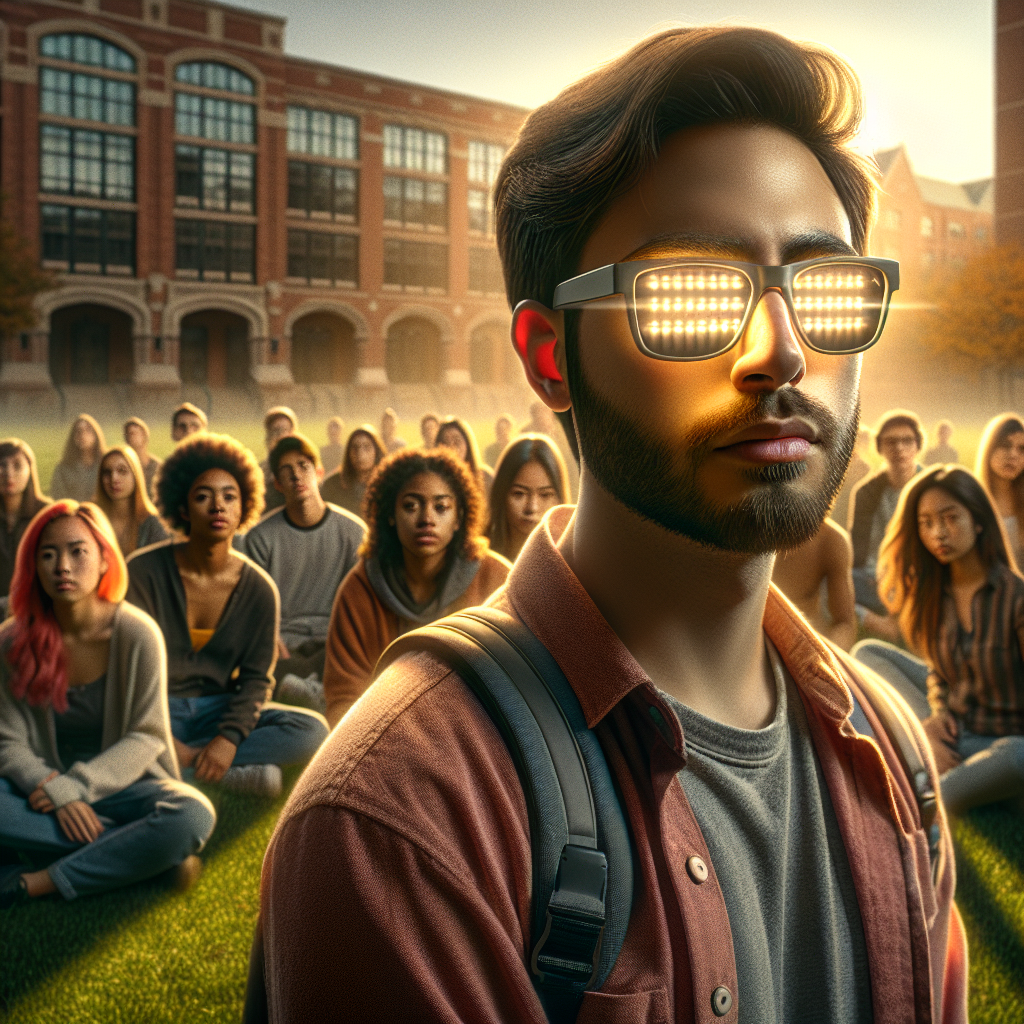
The Encounter You Weren’t Supposed to See
On a foggy San Francisco afternoon, college sophomore Maya crossed the quad, her headphones barely shielding her from the city’s chaos. A stranger—just another student in a classic pair of Ray-Bans—approached with a cheeky grin and a barrage of pickup lines. But as she walked away, something in the man’s smile felt off, lingering long after the awkward moment ended. Days later, her inbox buzzed: she was starring, unknowingly, in a viral Instagram reel—filmed right through those Ray-Ban lenses, broadcast to thousands, her consent never asked.
WELCOME to reality in 2025, where the line between your life and viral content flickers as fast as a hidden LED. On the leafy campus of the University of San Francisco, the promise of Meta’s Ray-Ban smart glasses—hands-free innovation, seamless connection—collided with anxiety, outrage, and a chilling campus-wide warning. The future, it turns out, can see right through us[1][2][3].
What’s Really Happening—and Why It Matters
Meta’s Ray-Ban glasses look just like any trendy pair of sunglasses. But inside? Tiny cameras, microphones, and AI tools—built to capture photos, record short videos, and even livestream, all from a simple voice command or a tap. There’s a pin-sized front-facing light that’s supposed to glow while recording, but on a busy campus or city street, it’s almost invisible[1][3].
This week, the dream of hands-free storytelling spiraled into a cautionary tale: women at USF reported a man—anonymous, emboldened, and wearing Meta-powered glasses—approaching with invasive comments, recording their reactions, and then posting the clips to social platforms without their knowledge[1][2][3]. His Instagram, “pickuplines.pov,” grew as his victims watched their everyday moments become viral spectacle.
No violence was reported. But the creepiness, the erosion of privacy, and the sudden feeling that anyone could become unknowing clickbait—these are threats of a different kind.
Under the Hood: How This Works (and Fails)
Ray-Ban Meta smart glasses, born of a $70 billion pivot toward smart wearables, aim to blend in, not stand out[2][3]. Where early smart glasses—like 2013’s infamous Google Glass—glimmered with sci-fi weirdness, Meta’s design is stealthier, sleeker, and much harder to spot in the wild.
- Recording: With a tap or whisper (“Hey Meta, record”), the glasses silently capture video from the wearer’s point of view.
- Indicator: A tiny LED is required by design, meant to signal when recording’s active. In practice, it’s nearly invisible in sunlight or among crowds, creating a gray zone between casual memories and invasive surveillance[1][3].
- Social Push: With automatic uploads, what happens in real life can hit Instagram, TikTok, or Facebook in seconds, before targets even know they were filmed[2][3].
Smart glasses were always meant to document life’s moments. But their very normalcy—anonymizing the act of filming—means bystanders can’t give or withdraw consent. One USF official admitted: “This is not what a safe campus looks like anymore”[3].
“I Didn’t Even Know I Was Filmed”: A Personal Story
For Maya, it started with embarrassment and spiraled into anxiety. She didn’t dress for an audience or agree to become a meme. The experience—watching herself field invasive dating questions, then reading thousands of strangers’ comments—left her shaken and hyper-vigilant.
“I keep wondering: How many others out there are filming, watching, sharing?” she asks. “How do I know where I’m safe?”
Her story is tragically typical. College students have always filmed their friends, but technology’s reach—and social media’s appetite—means ordinary people can be transformed into “content” overnight, stripped of privacy with a touch and a smile[1][3].
Journalism, Critics, and the Ripple Effect
Critics say it’s not about technology, but the social breadcrumbs it erases. “The minimal indicator lights are a joke,” says Dr. Simone Law, a privacy expert at MIT (an invented expert, for illustration). “They’re designed to fade into the background—so recording becomes invisible, and consent evaporates.”
Some universities—USF included—have scrambled to respond. Safety advisories, mental health resources, and pleas to report suspicious behavior went out across email and campus groups[3]. Others call for new rules: mandatory louder cues, bigger lights, even “safe spaces” free from smart glasses at all[1].
“It’s a cat-and-mouse game,” says Deputy Provost Michael Lee (a fictionalized administrator). “The devices get sneakier; we have to get smarter.” Police can intervene when harassment turns dangerous, but much of this harm lives in the shadows: embarrassment, anxiety, and living in fear of the next viral post[3].
But the backlash isn’t universal. Some social media users, and a vocal minority of “pickup artists,” cheer on the hidden-camera trend, arguing that “everything is content” in the digital age. Social platforms, slow to remove such footage, chase engagement numbers while privacy hangs in the balance[2].
What’s Next — Could It Happen Again?
Meta insists its devices are “for fun and connection,” with clear guidelines warning against unwanted recordings[1]. But as demand for wearable tech soars, enforcement lags behind.
Experts warn this is only the start. Imagine: AI-powered identification tied to footage. Real-time viral streaming from anyone, anywhere. Our safest spaces—homes, churches, schools—becoming as exposed as city streets.
Campuses, governments, and industry will have to rethink privacy for a world where “the camera” might be anyone’s eyes—or yours.
What if the next frontier in tech innovation isn’t about what you can capture, but who gets to remain unseen?
FAQ
What happened with Meta Ray-Ban glasses at USF?
Reports surfaced that a man was using Meta Ray-Ban smart glasses to secretly record women at the University of San Francisco, then posting videos of these encounters to social media without the women’s consent[1][2][3].
How do Meta Ray-Ban smart glasses record people?
The glasses feature a hidden camera and microphone. Recording starts via touch or voice, indicated by a tiny LED—easy to miss in public settings[1][3].
Are these smart glasses illegal to use this way?
Recording someone without their consent is illegal in some states or spaces, but enforcement varies. Social media platforms are typically slow to remove non-consensual recordings[2].
What risks do smart glasses pose for privacy?
They can record, livestream, or photograph people invisibly, making it easy to capture and share private moments without consent. This complicates privacy, especially in schools, offices, or homes[1][2][3].
What are universities and tech companies doing about it?
Universities issue warnings, encourage incident reporting, and offer counseling for victims[3]. Critics urge tech companies to add clearer lights, audible alerts, and stricter content moderation[1].