
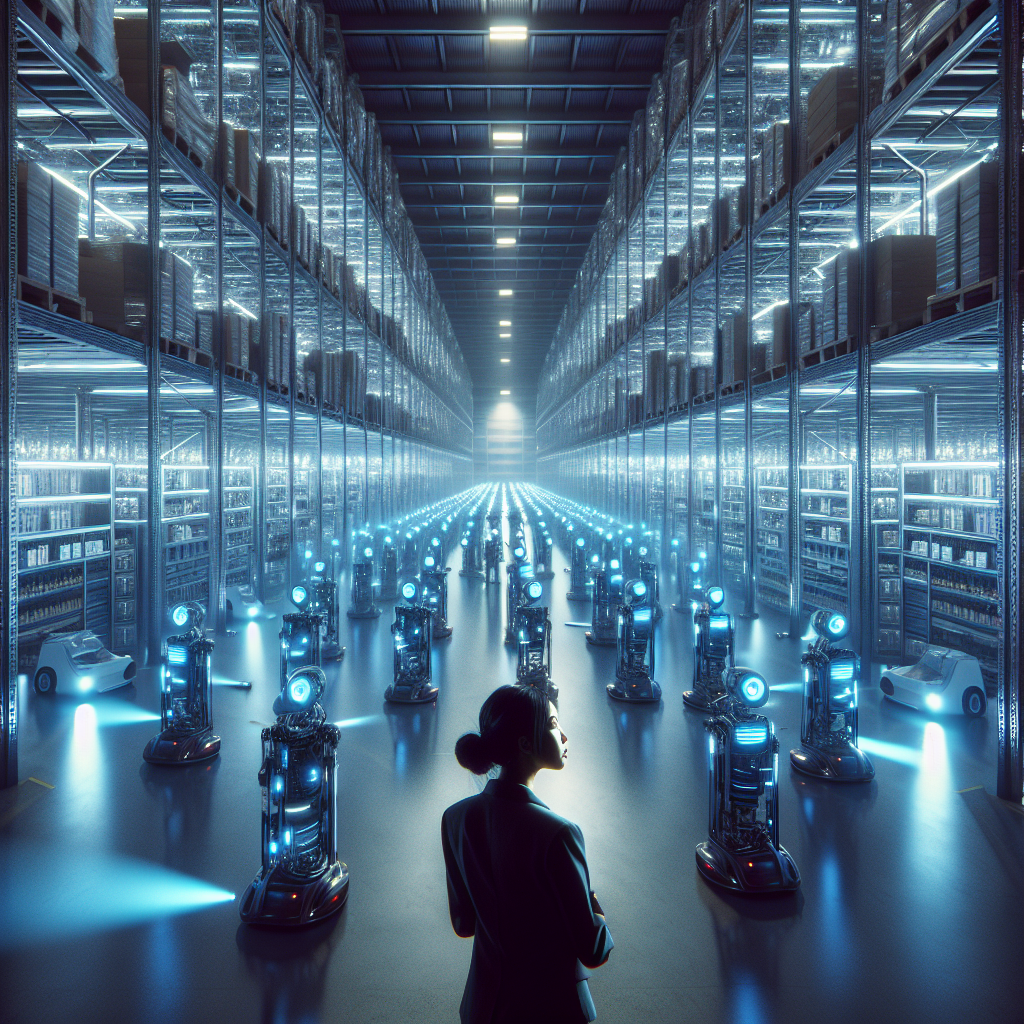
The Whirring Night That Changed History
It was 3:11 AM when the humming intensified on the warehouse floor outside Tulsa. Jared, a night-shift line worker, paused—just for a moment—to listen. The usual mechanical symphony had deepened into something new: a swarming, intelligent ballet. Overhead, red and blue indicator lights pulsed as hundreds of boxy, waist-high robots darted in perfect rhythm between towering stacks of packages. On the distant catwalk, a manager typed rapidly into a terminal, the screen blinking with the words: “DeepFleet AI: Autonomous Orchestration Engaged.”
Jared never saw the memo, but tonight was the experimental launch of Amazon’s new robotics fleet, powered by a generative AI model designed to reshape not just the warehouse, but the very definition of work itself.
What’s Happening—And Why It Matters
Amazon, already famous for its logistics magic, has quietly crossed a threshold: over one million robots now roam its global facilities[2][3]. This isn’t just more automation—it’s an orchestrated leap, marrying artificial intelligence with machine autonomy to supercharge warehouse efficiency. Dubbed a “robot revolution,” this rollout is poised to automate up to 75% of Amazon’s U.S. operations by 2033, replacing an estimated 600,000 roles[4][5].
This seismic shift isn’t happening in a vacuum. It’s arriving precisely when labor shortages and relentless delivery expectations are colliding with the razor-thin margins of modern e-commerce[2]. The question is not “Will robots take over?” but “What happens now that they have?”
How Does It Work? The New Face of Fulfillment
Unlike the clunky robots of yesterday, Amazon’s new fleet is a coordinated army of mobile machines. Each unit is powered by DeepFleet, a proprietary AI “traffic system” that dynamically routes robots like cars through a city, minimizing bottlenecks and maximizing speed[3].
-
Sequoia: This AI-driven robot manages inventory at lightning speed—finding, storing, and moving products 75% faster while reducing workplace injuries by handing items at optimal heights[1].
-
Hercules: A drive-unit that fetches entire shelves for workers, using 3D cameras and encoded floor grids to navigate the chaos and keep humans safe[1].
-
Sparrow & Cardinal: Specialized arms that can “see” and pick up nearly any object, learning from new products on the fly[2].
Everything is wrapped into a data-rich Amazon Web Services ecosystem, which means robots are learning, adapting, and collaborating in real time[1][3]. The goal? Packages packed and shipped in record time, with a fraction of the human labor.
Whose Jobs Are at Stake? And Who Decides?
A leak from Amazon’s internal planning details a roadmap: by 2027, some 160,000 warehouse jobs could vanish, with operational costs dropping by 30 cents per package[4][5]. For Wall Street, it’s manna; for the warehouse worker, it’s a thunderclap.
According to Dr. Lila Garcia, a tech labor analyst, “This isn’t just about lost jobs. It’s about who decides the future of work in America—corporations, communities, or the code itself?”
Amazon has countered with a different narrative: that robotics and upskilling—training humans to work alongside machines—will “secure safer, better jobs for all” and that 60% of their employees report higher satisfaction when robots relieve the most repetitive, dangerous tasks[1].
A Life Rewritten: One Worker, One Shift, One Choice
For Jared, reality cut deeper than any press release. After breaks shortened and output quotas ticked higher, he faced a decision: sign up for retraining, take a severance offer, or look for work elsewhere as robots filled in night after night. For single parents, older workers, or anyone who can’t pivot into an IT-driven role, the stakes are clear—fortunes and futures teeter with every deployment.
Ripple Effects: Reactions, Riots, and the Road Ahead
Unions have sounded the alarm, labeling the rollout “the largest labor displacement in a generation.” Lawmakers in states from California to Ohio have tabled emergency bills demanding new forms of worker protection, retraining, and AI transparency. Some cities—like Seattle—have even explored taxes on “robot labor hours” to fund basic income experiments for those squeezed out.
Industry, meanwhile, races to keep up. Competing retailers scramble to match Amazon’s pace or risk extinction. Robotics startups boom, pitching ever-smarter arms and more collaborative algorithms[2].
And in the background, a wary public watches as the once-invisible world of warehouse labor is dragged into the center of America’s economic debate.
What’s Next—And Could It Happen Again?
As the dust settles, big questions loom: Will other industries follow Amazon’s path? Can workforce reskilling keep pace with AI’s acceleration? What happens to local economies if automation outstrips job creation for good?
Tonight, Jared finishes another shift, shadowed by machines that never tire. Tomorrow, a new DeepFleet update rolls out.
Will the next revolution in robotics rewrite the social contract, or will we find new ways to put humanity back at the center?
What do you think—should we race toward full automation, or pull the brakes before we leave too many behind?
FAQ
Q: What are Amazon’s leaked robot automation plans?
A: Amazon aims to automate up to 75% of its operations by 2033 using advanced robotics and AI, potentially replacing as many as 600,000 warehouse roles[4][5].
Q: How do Amazon’s new warehouse robots work?
A: The robots, coordinated by AI systems like DeepFleet, autonomously move, sort, and package items, reducing errors and increasing speed[1][2].
Q: What impacts will this have on the workforce and local communities?
A: Massive displacement of warehouse jobs is expected, prompting calls for new worker retraining programs, policy changes, and experiments with basic income.
Q: How have employees reacted to robot integration?
A: Some report higher job satisfaction due to safer, less repetitive work, while others face uncertainty or displacement[1].
Q: Is Amazon alone in this shift to warehouse automation?
A: No. The race for robotics is industry-wide, with retailers and logistics companies adopting similar technologies to meet e-commerce demand[2].