
The Moment Everything Changed
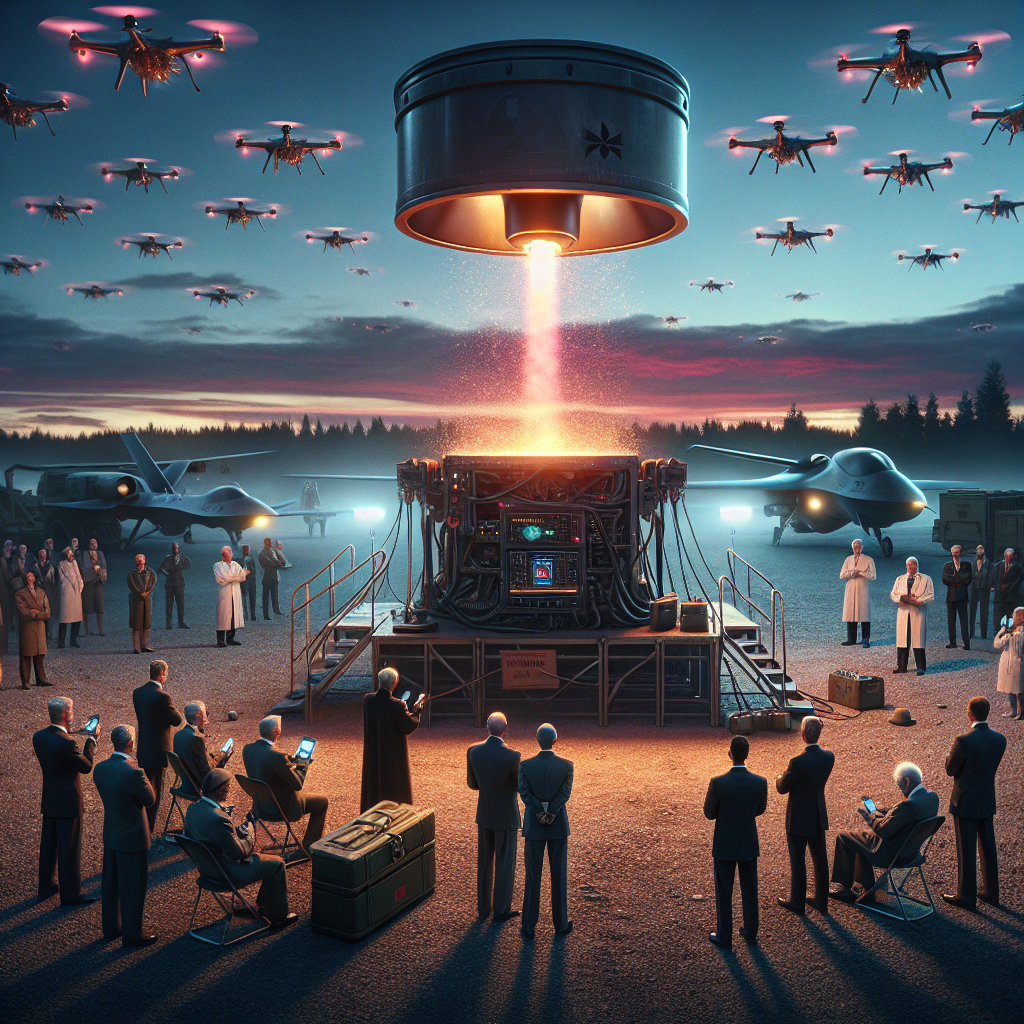
August 2025, Camp Atterbury, Indiana. The summer air vibrated with tension as defense officials, engineers, and Congressional staffers gathered behind secure barriers. Suddenly, a swarm—dozens of lightweight drones—rose above the treeline, buzzing like a metallic locust cloud. In the heart of the demo field, a single machine turned and hummed to life. With a soft, invisible pulse, the air itself seemed to tremble. The entire swarm—49 drones—fell from the sky in a synchronized ballet of defeat. Some gasped, others cheered. All understood: warfare, and the very meaning of airspace security, had changed forever[3].
Why This Weapon Matters Now
For years, the world’s military strategists have obsessed over the “drone swarm problem.” Cheap, disposable drones—once the stuff of hobbyists—now threaten everything from airports to army bases[3]. Bullets and missiles can target one drone at a time. But what happens when dozens, or even hundreds, attack at once? Until now, defenders played a losing game of high-tech whack-a-mole.
That’s where high-power microwave weapons—like Epirus’s Leonidas—come in. Using bursts of focused electromagnetic energy, these systems “fry” the delicate electronics inside drones, causing them to drop instantly without dangerous shrapnel or collateral damage[1][2]. In August’s live demo, no fewer than 61 drones—49 in a single burst—tumbled, their circuits disrupted or destroyed[3].
How It Works: The Science Behind the Sizzle
It sounds like science fiction, but the principles are elegantly simple. Leonidas, inspired by the legendary Spartan king, projects a broad, targeted “force field” of microwaves[2][3]. Unlike jamming, which merely confuses a drone’s controls, microwaves physically overload electronic components—causing instant failure.
What makes this generation of weapons revolutionary is threefold:
- One-to-Many: Unlike lasers or traditional anti-drone missiles, a single pulse can down an entire swarm at once.
- Precision: The energy is calibrated to minimize risk for humans who might be caught in the crossfire[3].
- Mobility: New semiconductor tech means these units are now compact, rugged, and battlefield-ready with twice the previous range[3].
As Epirus CEO Andy Lowery explained, “It’s not about finding or tracking every drone. It’s about creating a shield—an energy bubble—where no hostile drone survives”[2].
“I Heard a Crackle—Then Silence”: Through a Worker’s Eyes
Maria Gutierrez, a grain elevator operator in a Midwest town, used to worry every time sighting reports came in: mysterious drones overhead, possibly surveilling their critical infrastructure. In 2025, her workplace was chosen for a live-fire demonstration of the technology.
“I watched as the team fired that thing. Suddenly, it sounded like a weird electrical storm… then every drone just—stopped. No explosions, no flying pieces. The sky went quiet, just like that. The relief I felt… I knew we could get back to work, safe.”
Her experience echoes that of soldiers, air traffic controllers, and everyday people who’ve lived beneath the shadow of drone threats. For them, the victory was personal.
Defense Analysts and Skeptics Weigh In
Not everyone cheers unconditionally. Defense analysts praise the “one-to-many” strategy as a decisive leap in counter-drone tactics. Dr. Samuel Han, senior analyst at the RAND Corporation, calls it: “A paradigm shift. For the first time, defenders have a true answer to cheap drone swarms.”
Yet privacy advocates voice concern about overreach. Could similar tech be used against protesters’ cameras? Civil liberties groups urge clear limits on use.
Meanwhile, Pentagon officials stress this is “layered defense.” As Colonel Dana Warren told Congress: “Microwaves aren’t the only answer. But they finally give us a shield a determined enemy can’t easily bypass.”
The Ripple Effect: Governments, Industry, and Public Response
After the demonstration, U.S. military leaders immediately greenlit expanded procurement, setting off a scramble among allied nations and defense startups to secure access[2]. Airports, event organizers, and energy firms have started eyeing versions tailored to protect civilian infrastructure[3].
Russia, China, and other adversaries are reportedly accelerating their own microwave projects. The drone-arms race just escalated.
At community meetings, farmers and city workers ask: “Can we buy one?” For the first time, local governments discuss protecting water towers, clinics, even public parks.
What’s Next: Could It Happen Again?
As drone technology evolves, so will the weapons built to defeat it. Future microwave systems may fit in a truck, or portable backpack. Militaries worldwide prepare for countermeasures—drones with hardened electronics, decoys, or unpredictable flight paths.
But tech’s march is relentless. And as long as the skies fill with cheap, clever robots, the need for an invisible shield—one that can swat them down in an instant—will only grow.
So here’s the question: If the very fabric of modern conflict changes with a single invisible pulse, what should we protect most—and who decides where that force field stops?
FAQ
How does a high-power microwave anti-drone system work?
A high-power microwave (HPM) anti-drone system emits focused electromagnetic energy pulses that overload and disable drones’ electronic circuits, causing them to crash[1][2][3].
What is the Epirus Leonidas?
Epirus Leonidas is an advanced HPM weapon designed for military and infrastructure defense, capable of taking out entire drone swarms with a single pulse[2][3].
Are microwave anti-drone weapons dangerous to people?
Current systems are designed to neutralize drones while being safe for people in the target zone, but experts caution that usage protocols and exposure limits matter[3].
Can civilians use microwave anti-drone systems?
While commercial versions are being developed for critical infrastructure, civilian or private use is currently restricted by government regulations[2][3].
What industries or public facilities are most likely to adopt this tech?
Airports, utilities, event venues, and government agencies are top candidates as drones become more prevalent[2][3].
Are there ways drones can counter microwave attacks?
Engineers are exploring drone designs with shielded electronics and evasive maneuvers, but HPM systems will likely adapt in response.
Will we see more countries deploying these weapons?
Yes—the demonstration has “shattered the ceiling,” and other governments are fast-tracking similar tech in response[2][3].