
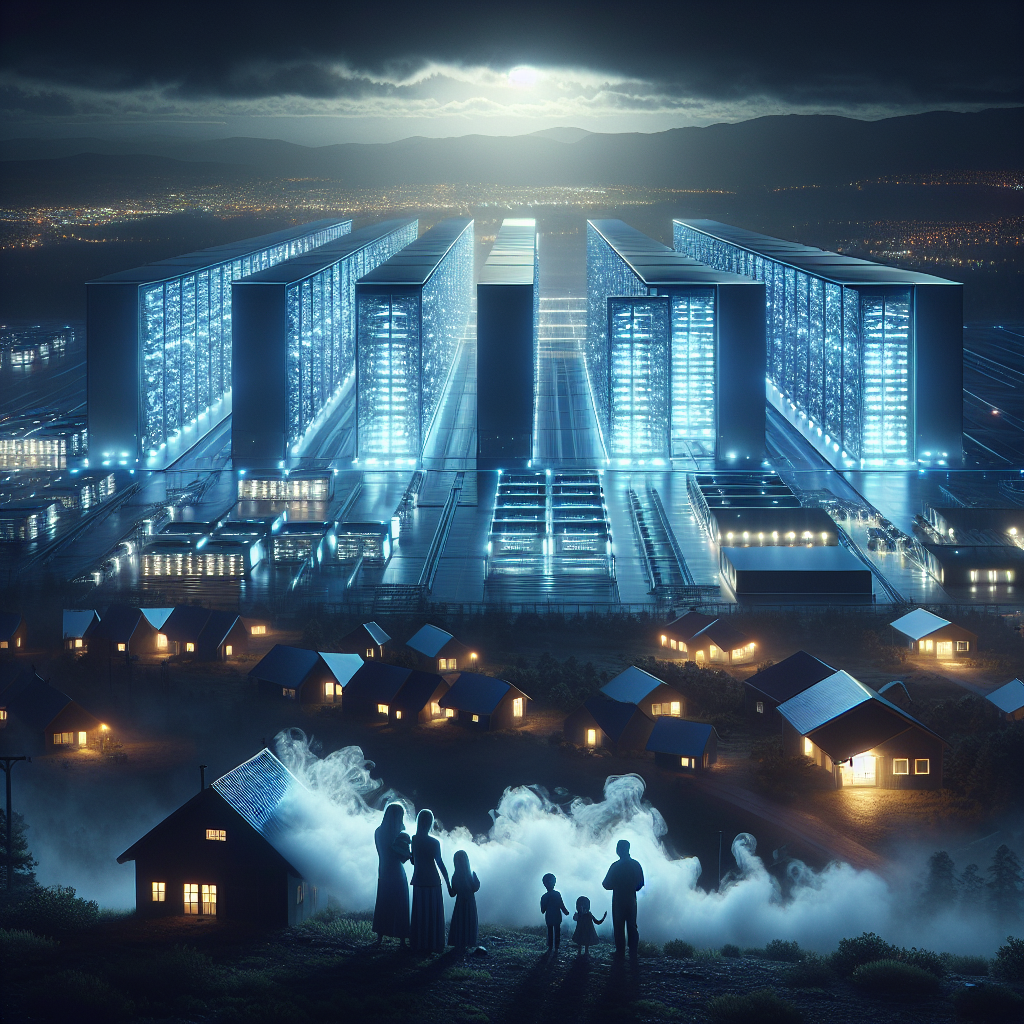
Midnight in Washington: A City That Never Sleeps
In the heart of Washington State, as dusk falls and neighborhoods blink to life, something different churns on the city’s outskirts. Employees pile into unmarked shuttles while a distant hum—almost orchestral—echoes across the fields. This isn’t your typical night shift. Inside, rows of computer racks blink and whir, feeding the world’s insatiable hunger for artificial intelligence. These are the new cathedrals of our digital age: AI data centers, where the world’s memory is being swallowed at astonishing speed[3].
What’s Really Happening?
Over the past decade, technology has been evolving rapidly. AI—artificial intelligence, systems that can learn and do complex tasks on their own—now powers everything from voice assistants to global logistics. The secret sauce behind AI’s surge? Data. Oceans of data, processed and stored with astronomical speed.
To make this possible, companies have built massive AI data centers: gigantic, energy-hungry facilities packed with processors designed to crunch numbers, discover patterns, and train AI models[2]. These centers don’t just run websites—they ingest the world’s information, analyze it, and feed it back into the technologies shaping our lives.
Why Should You Care? The Stakes
This relentless expansion is more than a tech story. It’s rapidly remapping how we use natural resources. Experts estimate that demand for AI-ready data center capacity will grow 33% per year until 2030[2]. Investment in these centers is predicted to triple, reaching nearly $1 trillion by 2030[3]. Today’s data centers are being retro-fitted and reimagined—largely because new hardware (like graphics processing units, or GPUs, which specialize in massive, rapid number crunching) have changed the game. One center, once servicing a city, now draws enough electricity to power hundreds of thousands of homes[1].
Behind the Curtain: How These Data Centers Work
Modern AI data centers use specialized chips called GPUs that accelerate the training of language models—the same ones that power chatbots, smart cameras, and translation tools[2]. These chips are wired together in ultra-dense racks, each demanding fierce streams of electricity and flooding the building with heat.
They need cutting-edge cooling systems—think “wind tunnels” and liquid-cooling pipes just to survive the fiery demands. The total energy consumed doesn’t just go into running the computers. It keeps the machinery from melting down.
But there’s a new wrinkle: AI models require staggering amounts of storage to remember everything humans and machines feed into them. As the Reddit post spotlighted, the world’s memory and storage supplies—chips, drives, even rare minerals—are being squeezed by this never-ending demand[3].
The Human Perspective: Maya’s Story
Let’s follow Maya, a middle-school teacher in a small town where a data center recently opened. Residents first saw new jobs appear—operators, maintenance crews, security. But Maya soon noticed her energy bills creeping upwards, while the local utility warned that grid stability might waver during peak AI activity.
“I used to think of the cloud as something abstract,” Maya recalls, “but now I can see the shimmer of those lights through my window at night. It feels personal…like our town is part of something huge but fragile.”
Governments and Industry Scramble to Respond
The scale of this transformation has caught governments off guard. Regulatory agencies are pushing for massive upgrades to power grids, as the largest AI data centers begin drawing more energy than entire towns[1]. “These facilities are changing our infrastructure planning forever,” said an anonymous US Department of Energy official. “We’re worried about sustainability—and we’re worried about resilience.”
Job markets are shifting too. Washington State, for instance, has seen data center jobs double since 2018, leading to new local training programs and debates over livable wages[2]. Meanwhile, environmental concerns mount; some activists warn that if unchecked, data center electricity use will rival many traditional heavy industries by 2035[5].
Ripple Effects: From Chip Shortages to Global Tensions
It’s not just energy. The swelling appetite for memory—RAM, storage chips, hard drives—is causing supply squeezes worldwide. Analysts warn of mounting bottlenecks: prices go up, new laptops and smartphones become harder to find, and tech giants jostle for priority shipments[3].
On the environmental front, generative AI could be responsible for 60% of rising data center electricity needs, fueling urgent climate debates[5]. Communities near big data centers wrestle with water usage for cooling, and with the economic benefits—are the gains worth the hidden costs?
What’s Next / Could It Happen Again?
Industry insiders forecast even greater challenges ahead. Some predict 50,000-acre data campuses consuming up to 5 gigawatts each—the size of a city’s energy supply[1]. If hardware isn’t innovated to be more efficient, memory shortages and energy crises may become recurring headlines.
Governments, industries, and communities face a critical fork in the road. Will limits on expansion, new breakthrough chips, or radical cooling methods save the day? Or will the hunger for memory outpace everything else?
Provocative Question:
As AI data centers swallow more of our world’s memory and resources, who decides how far we go—and do we even know what we’re giving up?
FAQ
What is an AI data center, and why is it swallowing so much memory?
An AI data center is a facility filled with powerful computers—especially those using GPUs—to process and store massive amounts of data for AI systems. The exponential growth in AI applications drives huge demand for storage and memory resources.
Why are memory chips facing shortages?
Global demand for memory and storage chips has surged due to AI’s hunger for data. As data centers expand, they consume more of these components, leading to supply bottlenecks and higher prices.
How much power do AI data centers use—and what are the environmental costs?
AI data centers require dramatically more power than traditional ones. Their energy use is soaring, with some facilities consuming the equivalent of small cities, raising sustainability and climate concerns.
How does this affect ordinary people?
People may see changes in their local job markets, higher electricity bills, potential shortages or higher prices for tech products, and environmental changes near new data centers.
What are industries and governments doing to address these issues?
They’re upgrading power grids, regulating expansion, training new workers, and encouraging innovation in energy-efficient hardware and cooling systems.
Could the memory shortage become a long-term crisis?
Experts warn that if demand keeps outpacing supply, chronic shortages, higher costs, and more intense environmental impacts may become the new norm.
How might communities benefit or lose out?
Communities gain jobs, but may also face higher bills, greater resource usage, and increased pollution or climate risk.