
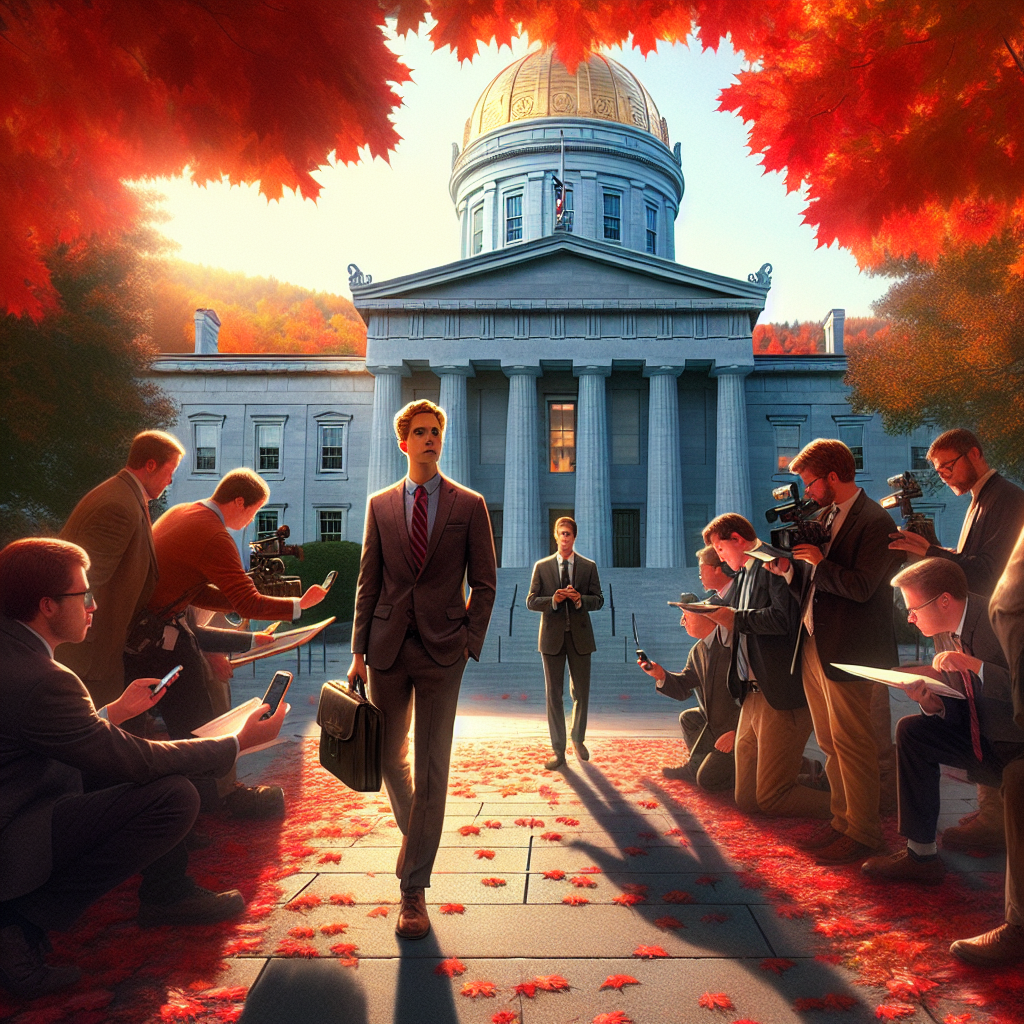
A Chilling October in Montpelier
The corridors of Vermont’s State House were unusually silent on the brisk October morning when word first spread: Senator Samuel Douglass was stepping down⸺not for a policy gaffe or public blunder, but for something far more contemporary, insidious, and irreversible. In the hush outside Committee Room 117, aides exchanged glances with faces pale as the first frost of fall. In less than 24 hours, a politician’s digital footprint had rewritten the trajectory of a nascent career and sent ripples across the Green Mountain State[2][3].
The Young Senator: Rural Roots, Meteoric Rise
Samuel Douglass, still just 27, seemed at first like Vermont’s answer to a new breed of politician: grounded, hard-working, populist but service-oriented. He grew up in Jay and North Troy, scraping through cold winters, attending public schools, juggling odd jobs in food service and hospitality while earning a social sciences degree at Johnson State College[1][3].
By his late twenties, Douglass was already woven into the Northeast Kingdom’s social fabric. He managed a modest organic farm with his wife, sold real estate, served as a Justice of the Peace, and volunteered for Meals on Wheels[1][3][4]. Locals described him as steadfast, neighborly.
His campaign—focused on affordable housing, rural health, and community—felt authentic. When he won the Orleans District seat in November 2024, his ascent was credited to the kind of grass-roots credibility most politicians covet but rarely earn[3].
Private Words, Public Reckoning
But Vermont’s newest senator also lived in an era where digital boundaries dissolve in an instant. That lesson hit home like a winter squall. In early October 2025, Politico published an exposé: a leaked private group chat among high-ranking Vermont Young Republicans revealed racist and antisemitic remarks, open support for ideologies most Americans abhor—including Nazism and white supremacy. Douglass, once chair of the state’s Young Republicans, was named as a participant[2][3][2].
Vermont’s political establishment, both left and right, recoiled. Governor Phil Scott made a rare unequivocal statement, declaring that “Vermont’s public servants must reflect the values of the people they represent.” Party leaders joined his call for Douglass’s resignation, citing not specific words but collective moral responsibility for the company he’d kept and the line he’d crossed[3].
How the Digital Leak Happened
The digital “smoking gun” was a group chat—a space originally meant for strategy and camaraderie among Young Republicans. Like many such digital forums, its informality became its undoing. A disgruntled former member had screenshot months of conversations, archiving the worst: slurs, conspiracy theories, and celebration of extremist ideologies[2][3]. The file made its way into the inbox of a national political reporter. Within days, Vermont’s leadership was staring down the barrel of a full-blown legitimacy crisis[3].
This mode of exposure is not new, but its power is growing. Political operatives, cyber analysts say, now see “oppo research” not just in old voting records but in every keystroke and inside joke stored on a server. “It’s the paradox of the digital age,” explains Dr. Nina Halberstam, a political technology analyst. “Leaders want authenticity and connection but forget that private digital spaces are just a screen capture away from public shame.”
For Vermont Citizens, It’s Personal
Consider the Johnson family in Westfield:
Sarah, a third-generation teacher, recalls how she once voted for Douglass. “He came to my son’s soccer game and asked about our health insurance. He seemed real,” she sighs. When news of the leak broke, her family gathered around the kitchen table, talking candidly about racism, digital privacy, and what true leadership means. For her, the episode wasn’t abstract. “I want my kids to know people can make mistakes, but some lines can’t be uncrossed.”
The Official Response and Political Fallout
Vermont’s response was swift. State Senate officials promised a review of internal conduct policies. The Republican Party publicly distanced itself from Douglass, and even traditional allies quietly scrubbed their endorsements[3]. In the legislature, Douglass’s committee appointments vanished overnight; his former colleagues issued statements centering on “dignity” and “restoring trust.”
The story bent politics and media into a single question: How do we judge the private digital utterances of our public leaders?
The National and Tech-Side Ripple Effects
Douglass’s fall lit up cable news and became a case study for digital ethics in politics. Party officials nationwide called emergency meetings to remind staffers that every chat, DM, and “private” joke is potentially immortal. Some states announced new candidate vetting tools that use AI to scan social media for red flags—raising their own privacy worries.
What’s Next: Can This Happen Again?
With Douglass’s official resignation pending, Vermont voters and the wider political class are reckoning with some sharp realities. Networked life means there’s no such thing as private bigotry for public figures. But tech experts warn: as we automate digital scrutiny, will context, forgiveness, or honest debate be the next casualties?
What happens when our leaders’ every word—public or not—is always one leak from changing history? Join the conversation.
FAQ
Who is Samuel Douglass and why did he resign?
Samuel Douglass, a Vermont state senator, resigned after being linked to a leaked Young Republicans chat that included racist and antisemitic remarks.
What was in the leaked group chat?
According to reports, the chat contained slurs, antisemitic comments, and open support for extremist ideologies among multiple participants.
How did Vermont officials respond?
Both Democratic and Republican leaders swiftly condemned the comments. Governor Phil Scott and other party heads urged Douglass to resign to maintain public trust.
Could similar political scandals happen in other states?
Absolutely. Political analysts warn that the digital nature of politics makes all private messages potential liabilities, especially in leadership roles.
How has this impacted Vermont politics?
There’s an increased focus on digital ethics, candidate vetting, and what constitutes public accountability—even in private digital conversations.