
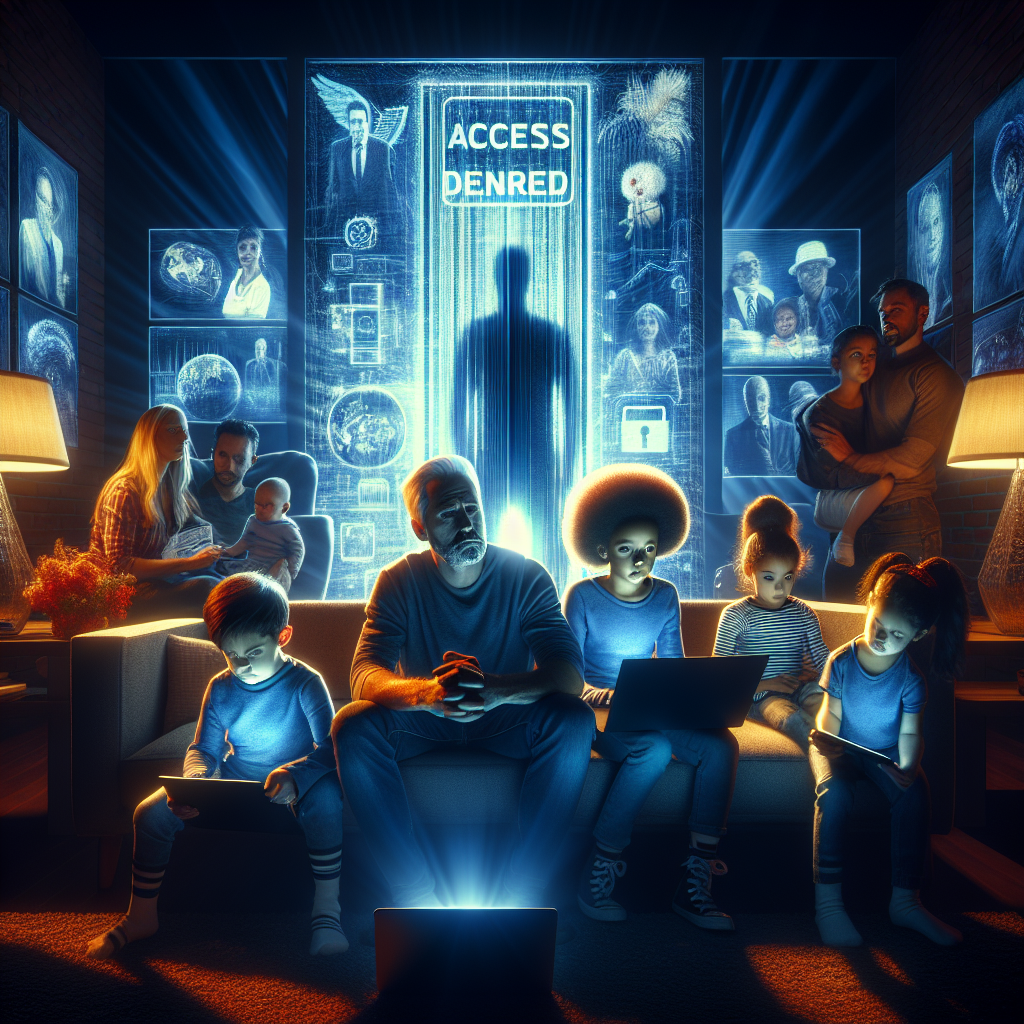
1: A Moment Frozen Online — Americans Facing Closed Doors
It’s a humid Thursday night in St. Louis, and Taylor, a freelance graphic designer, leans over her laptop. She’s clicking “Sign Up” for a cutting-edge European AI image tool — the kind redefining creative work. Instead of the usual welcome page, a digital wall rises: “Service not available in your region.” Taylor slumps in her chair, her frustration matching thousands of Americans who, this year, found themselves shut out of global platforms, software, and services once just a browser away.
But behind this moment — behind closed logins and blocked innovation — sits a seismic shift in U.S. tech policy. The Trump administration’s newest playbook isn’t just reshaping federal AI. It’s drawing new borders for the everyday American, changing who can access technology, and pushing the nation’s role in the digital world to a crossroads[1][2].
2: The New Playbook — American AI for Americans
In April 2025, the White House announced a sweeping AI policy overhaul. Framed as “Removing Barriers to American Leadership in Artificial Intelligence,” these executive actions aimed to booster American innovation, cut bureaucratic red tape, and enforce “Unbiased AI Principles” — mandating truth-seeking and ideological neutrality across federal systems[1][4].
Federal agencies were ordered to:
- Purchase only large language models (think: ChatGPT, Alexa) proven to generate truthful and nonpartisan answers.
- Revoke use of older civil rights–oriented data practices (disparate-impact liability)[3].
- Channel funding toward American-built “AI stacks” (layers of tech powering AI), and fast-track data center construction for home-grown solutions[1].
In short, only tech that mirrors the administration’s reality — and passes ideological muster — is welcomed through the government’s digital gates[2].
3: How It Works — New Barriers, New Exclusions
What does this mean for Taylor and millions like her? The executive orders redefined procurement, forcing agencies to filter out overseas apps and services not built on American code or not sufficiently “aligned.” Global companies, wary of lengthy compliance checks and uncertainty over political definitions, began geo-blocking U.S. users.
For private citizens, it translated to shrinking choices and access. Imagine relying on a European cloud tool for your small business — overnight, you’re forced back to costlier, often inferior alternatives developed domestically[2][5]. The ripple touches the freelance designer, the remote worker needing translation software, even schools that were expanding tech-driven learning.
At the heart, Trump’s strategy frames competitive advantage around “security” and “ideological neutrality.” Supporters say it’s long overdue to keep hostile actors and political agendas out of federal workflows[1]. Critics warn it’s an information iron curtain, depriving Americans of global innovation while giving partisan gatekeepers excessive control over digital reality[2].
4: Human Impact — A Family Left Offline
Let’s put names to the drama. The Robles family in Texas — parents, two kids, both enrolled in remote summer classes — were using a popular international language-learning app, vital for homework and cross-cultural exchange. One morning, the service vanishes. The family receives an apologetic email: “Due to new government policies and uncertainties, we are unable to serve users in America.”
Mom scrambles for alternatives, discovering that federal grants now support only U.S.-based edtech tools. The children lose a connection to their Spanish-speaking relatives abroad. Learning, once vibrant and borderless, now feels like a walled garden[1][3].
5: The Power Players — Reactions Across the Spectrum
Tech giants watch nervously. An anonymous executive at a Silicon Valley AI firm notes, “The procurement rules sound logical — but in practice, they force us to degrade our models or cut features to fit political benchmarks. The result? Less reliable AI and shrinking global trust.”[2]
Policymakers like Lynne Parker at the White House OSTP defend the move, claiming, “American innovation was losing ground because of bureaucratic inertia. We’re leveling the playing field and protecting civil liberties.”[4] But privacy advocates warn that ideological neutrality is often weaponized to erase discussions about discrimination, climate change, or LGBTQ rights[2][3].
Internationally, Europe and Asia respond with their own tech restrictions, feeding a digital Cold War where global knowledge is partitioned by flags, not shared across borders.
6: What’s Next / Could It Happen Again?
As the executive orders’ dust settles, federal agencies scramble to comply, tech companies rush to localize or exit, and American users brace for more disconnects[5]. With AI’s warp-speed evolution, the policies could re-shape not just what Americans see and use, but who participates in the future digital economy.
So, will access shrink as “American AI” rises? Can innovation thrive if it’s locked within a single worldview?
The very question hangs in the air:
Should technology serve only those whose reality matches the policymakers in power? Or is the true future of AI — like the internet — open, borderless, and infinitely possible?
FAQ
-
How do Trump’s AI policies affect software and service access for Americans?
The new executive orders and procurement policies push agencies to buy only American-developed tech, causing global companies to block U.S. users or withdraw entirely. -
Why are European and Asian tech companies blocking U.S. customers?
Uncertain compliance with ideological and security filters, plus unpredictable enforcement, motivate many to geo-block American users. -
What is “ideological neutrality” in AI procurement?
Federal agencies must only use AI systems that don’t “intentionally encode partisan or ideological judgments,” a benchmark criticized as vague and open to political interpretation. -
What are the personal effects for families and workers?
Blocked online learning apps, limited digital work tools, and narrower software choices are already hitting users, from students to entrepreneurs. -
Could these policies lead to wider digital isolation?
As other nations react with their own restrictions, there’s potential for a fragmented tech world—where American users have access only to services built and approved domestically.