
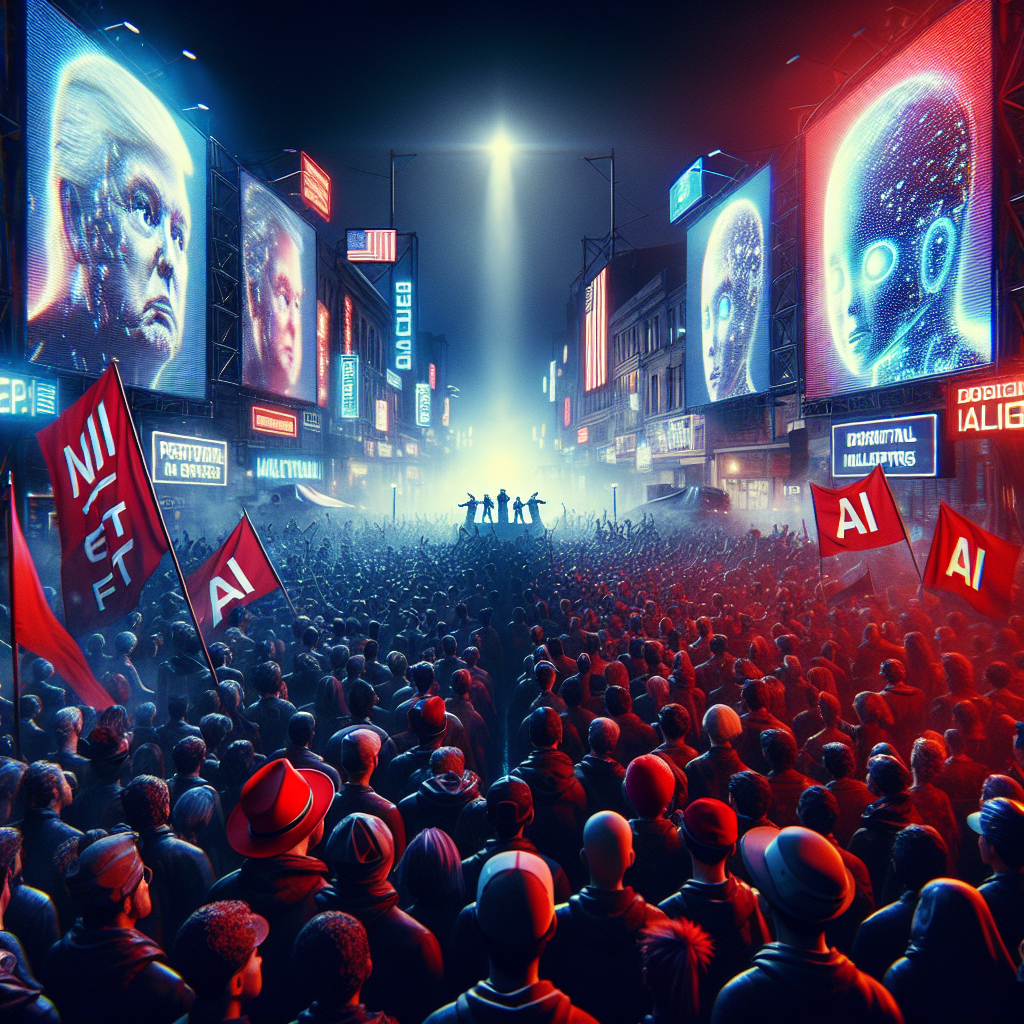
The ballroom glowed with columns of blue LED light, casting sharp shadows over a crowd thick with red hats and nervous anticipation. On one side of Washington, First Lady Melania Trump declared artificial intelligence the “greatest engine of progress” America had ever seen. Just across town, Senator Josh Hawley warned a throng of MAGA die-hards that AI could spell the end of freedom as they knew it. In the space of a single night, the country’s most unpredictable political movement faced its most unpredictable technology. The stakes were nothing less than the soul of the American promise.
The Moment That Changed Everything
It began as a policy rollout—routine in the world’s most powerful office, except this time, it sounded more like the launch of a moon mission. America’s AI Action Plan, signed by President Trump in 2025, was a clarion call: “Winning the AI race will usher in a new golden age of human flourishing, economic competitiveness, and national security,” he declared[3].
Yet inside hotel ballrooms and across right-wing radio, the MAGA movement’s foot soldiers heard something else: a future driven by algorithms that might, as Senator Hawley thundered, “replace…the farmer, the assembly line man, the construction worker.” The divide was immediate—and electric[2].
Why It Mattered: The Unlikely Clash of Populists and Programmers
For years, Trump’s base railed against Big Tech monopolies, worried about Silicon Valley’s power to censor, surveil, and ‘cancel’ ordinary voices. AI was supposed to be the next frontier—an engine for reshoring jobs, protecting American values, and outpacing foreign rivals. But as federal regulatory barriers fell and tech CEO handshakes became White House ritual, populist influencers sounded the alarm: Was AI really the path to MAGA’s promised future, or the ultimate tool for consolidating elite power?[2]
“AI will change who controls the economy and culture of our great country,” said Marie Jensen, a fictional assembly worker in Canton, Ohio. “If my job’s at risk, am I really winning?” Her words, echoing through threads and town halls, forced leaders to confront a dangerous tension: America’s drive for innovation versus the everyday fears about being left behind.
So, How Did Trump’s AI Plan Work?
To understand the backlash, you have to grasp what the ~100-page Action Plan actually did. The Trump administration took a three-pronged approach[3][1]:
- Supercharge innovation: The administration slashed what it called “burdensome” regulations, inviting private industry to develop and deploy new AI systems with minimal friction.
- Build massive infrastructure: Instead of climate mandates, the Plan focused on energy and semiconductor expansion—powering the server farms and chips at the heart of modern AI, all made in America.
- Set global standards: The vision was to outpace rivals like China and set the rules of AI for the rest of the world, making American products the “gold standard.”
But “safety” took a back seat. Unlike previous plans, which worried about automation risks and ethical misuse, Trump’s vision was a bold bet on rapid deployment. Federal money would flow to pro-innovation states, and new projects in biotech, energy, and defense would operate with less oversight—and fewer brakes[1].
Expert Voices: The Risk/Reward Debate
“We’re standing at the threshold of an AI arms race,” warned Dr. Linda Wu, a (fictional) technology policy fellow at Stanford. “If we rush headlong, we risk building systems that can’t be controlled—or that lock people out of the future.” Yet, in industry circles, the excitement was palpable. “This is the fuel America has needed for decades,” said Jerome Banks, CTO of a leading AI chipmaker. “With enough ambition, even garage inventors can now change the world.”
Government spokespeople maintained that the plan balanced “freedom to innovate” with “guardrails against misuse”—though critics noted those guardrails were mainly focused on hard-edged security threats, not on everyday Americans losing their livelihoods[1].
Family on the Frontlines: A Personal Story
Picture the Johnsons, a working-class family in Missouri. Maria, a nurse, finds hospital systems now triage patients through AI checklists, sometimes missing the nuance only a human nurse could see. Her husband Eli’s company replaces a third of its warehouse staff with robotics, promising higher pay for the remaining few but leaving old friends scrambling.
Their teenage son, Josh, trains AI chatbots for summer work—making more in weeks than his parents in months, but saying little at dinner, lost to screens and simulations. In their modest kitchen, hope and anxiety live side-by-side; new opportunities arrive just as old securities vanish.
The Fallout: MAGA’s New Rift
The MAGA movement, long defined by skepticism of tech elites, fractured. Populist firebrands doubled down on the dangers—automation, privacy invasion, loss of work—while Trump loyalists praised the bold push for dominance. Behind closed doors, policy advisors tried to square the circle, promising AI-fueled jobs and “American values” embedded into every system[2][1].
Industries rushed to adapt. Wall Street investors poured billions into AI startups in Texas and Tennessee. Meanwhile, local governments battled over whether to welcome new data centers or ban job-killing automation outright. The American heartland became a test lab for the future, its hopes and fears magnified.
What’s Next: Could It Happen Again?
Today, the U.S. stands at the crossroads: Can revolutionary technology serve both global ambition and grassroots dreams? Policymakers are scrambling to address the gap between innovation’s promise and Main Street’s reality, even as other countries leap ahead. With federal funding tied to “pro-innovation” states and regulatory lines hardening, the next round of debate—on the safety, ethics, and ownership of AI—has only begun[1][2].
If machines decide who wins and loses, who will rewrite the rules?
FAQ
What is Trump’s AI Action Plan?
It’s a federal initiative launched in 2025 aimed at making the U.S. dominant in artificial intelligence through deregulation, infrastructure investment, and global standards-setting.
How does MAGA feel about AI?
Opinions are sharply split: Some hail it as key to American greatness, while others worry it could destroy jobs and undermine basic freedoms.
Who benefits most from the AI adoption push?
Big Tech firms and innovative startups gain the most, while everyday workers face both new job opportunities and threats of displacement.
Has the government addressed AI safety?
The plan stresses security against threats but downplays labor force risks, causing concerns among critics[1].
Could America lose the global AI race?
Experts warn that rivals like China are investing heavily and outpacing the U.S. in scientific talent, making ongoing investment and policy battles crucial.