
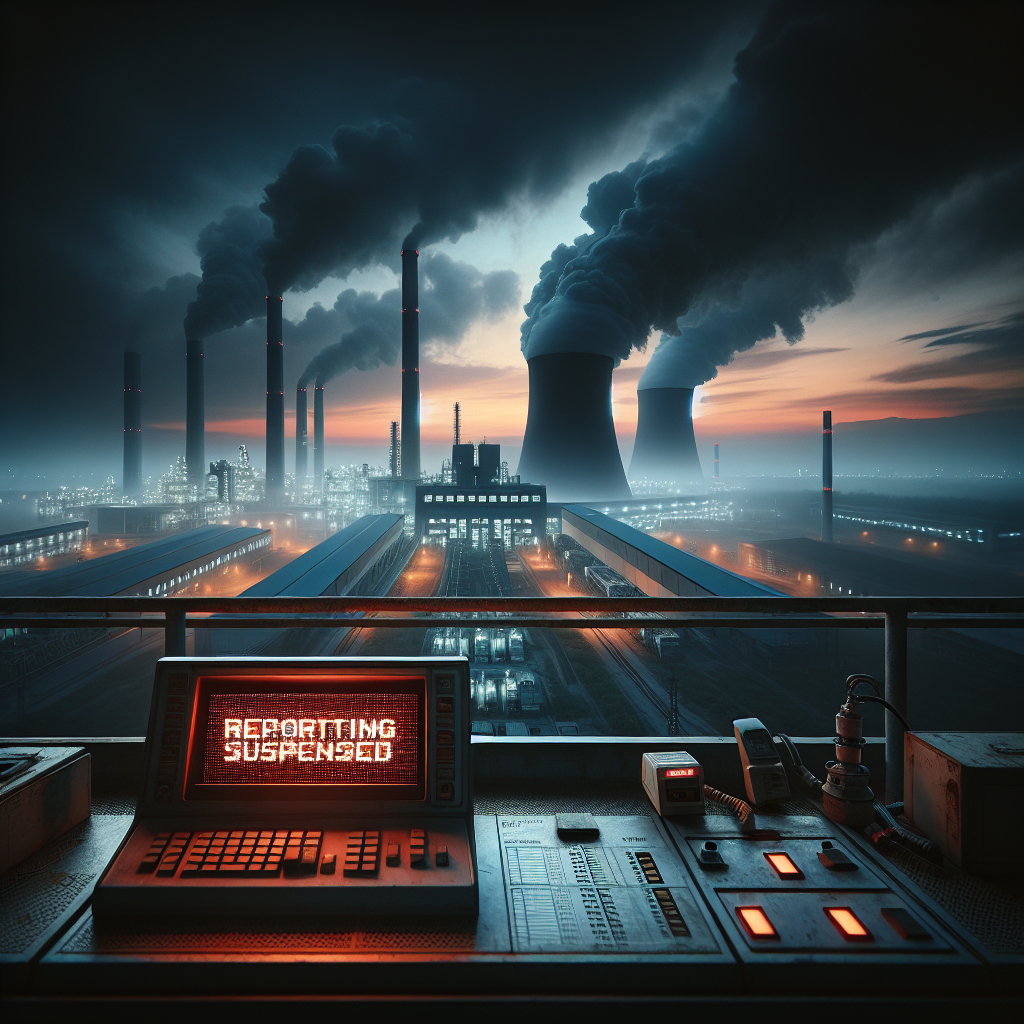
The hum of turbines fills the humid Texas air as Anna Torres—a shift supervisor at a sprawling coal-fired power plant—squints at her dashboard. For years, she’s reported every puff of CO₂, every spike of methane, watching federal trackers fill databases with the story of America’s biggest polluters. But today, Anna’s terminal blinks a simple message: “Reporting Suspended—Effective Immediately.” Outside, the smokestack’s plume looks the same, but for Anna and over 8,000 facilities nationwide, everything just changed.
A Silent Shift in the System
This summer, the United States Environmental Protection Agency (EPA), under the Trump Administration, ignited a seismic shift. In a flurry of executive orders and regulatory proposals, the agency began dismantling more than a decade of greenhouse gas (GHG) emission tracking—a move powerful enough to redraw the landscape of climate policy, energy economics, and public accountability[1][3].
At the heart of this upheaval: the plan to end the EPA’s federal Greenhouse Gas Reporting Program. Since 2009, the program has required power plants, refineries, and manufacturing giants to report exactly how much carbon dioxide, methane, and other potent greenhouse gases they release. The result was one of the world’s most comprehensive emissions databases, shaping policies, corporate strategies, and climate debates alike[3].
But on a steamy July afternoon, EPA Administrator Lee Zeldin declared, “Unlike other mandatory information collections under the Clean Air Act, the GHGRP is not directly related to a potential regulation and has no material impact on improving human health and the environment.” He announced the program’s end as a victory for business, predicting $2.4 billion in savings and “a significant step toward streamlining operations and cutting unnecessary red tape”[3].
Why This Data Matters
To the casual observer, federal emissions tracking might sound bureaucratic. In reality, it’s the backbone of American climate governance. The data underpins federal policy, empowers companies to prove progress to investors, and arms communities with vital information on local air quality and industrial risk[3].
Here’s how it works: Each year, major facilities calculate and submit their direct emissions—what they send up the stack or leak from pipelines. EPA analysts then verify and publish the results, giving researchers, state officials, and the public a clear (if sometimes alarming) picture of what’s entering our atmosphere.
By ending this visibility, critics argue, regulators, watchdogs, and everyday citizens could lose their best means of holding industry to account[3][4].
The Attack Vector: “Significant Contribution” Redefined
This rollback isn’t a standalone event. It’s the spearpoint of a larger assault on Obama-era and Biden-era climate regulations[1][2]. The legal linchpin? The EPA now proposes that fossil fuel power plants don’t make a “significant contribution” to greenhouse gases—the critical justification underpinning all federal emissions rules[1].
With that redefinition, the agency seeks to bury the 2009 “Endangerment Finding,” which previously forced it, by Supreme Court order, to treat greenhouse gases as pollutants threatening human health[1][4]. Without that foundation, rules capping emissions from power plants, cars, and even oil fields are suddenly up for repeal[5].
In a technical sense, these changes grind regulatory machinery to a halt. In the real world, they threaten to open the door for more pollution at precisely the moment climate scientists warn it’s time to slam it shut.
A Day in the Life: What Does It Mean for Americans?
Picture a family living downwind of a sprawling refinery in Louisiana. For years, their state officials, pushed by local advocacy groups, pulled EPA data to chart asthma rates, lobby for emission reductions, and win grants for cleaner schools. Now, as federal tracking halts and pollutants become harder to trace, the family wakes each morning to the same acrid air—but with less hope that anyone is counting—or cares enough to act.
Anna Torres, our power plant supervisor, remembers when environmental compliance sparked pride and transparency kept her company honest. Now, as EPA forms disappear from her inbox and oversight recedes, she worries the plant’s bottom-line focus might once again overshadow safety and climate responsibility.
Shockwaves Through Industry and Government
The reaction was immediate and polarizing. Industry leaders cheered the cut in compliance costs and new “operational freedom.” Climate advocates, meanwhile, warned of “a great data blackout”—with over 8,000 facilities suddenly less visible, and fewer roadblocks for super-emitters[3][4].
State regulators scrambled, hinting at setting up their own reporting frameworks. Some, especially in California and New York, began drafting emergency laws to keep emissions reporting alive, while others hesitated, wary of going it alone.
Internationally, U.S. trading partners raised alarm, questioning the credibility of American emissions reporting just as climate talks intensified. Investors—especially those longing for clean energy confidence—warned that “data darkness breeds distrust.”
What’s Next / Could It Happen Again?
For now, some facilities must still report emissions under separate provisions from the Inflation Reduction Act, but the EPA has proposed delaying enforcement until 2034—a nearly decade-long window of reduced transparency[3].
Congressional Democrats are drafting counter-legislation, but legal analysts say the Supreme Court will ultimately decide how far the rollback can go[5]. Behind closed doors, tech analysts are experimenting with satellite and AI tools to fill the data void—hoping, perhaps, that technology can do what regulation used to.
Will a new administration restore the data floodlights, or will the blackout shape a generation? As the American public is left piecing together the climate puzzle with fewer pieces, one question burns:
If we stop counting what we emit, do we stop caring who gets hurt?
FAQ
What is the EPA Greenhouse Gas Reporting Program?
The EPA Greenhouse Gas Reporting Program required major U.S. industrial facilities to submit annual data on their greenhouse gas emissions.
Why did the Trump administration end emissions tracking?
The administration says ending the program cuts red tape and saves businesses money, arguing the tracking was not necessary for health or environmental improvements.
Who will still track emissions?
Some facilities must still report under other laws, but most will see tracking requirements sharply reduced, with a decade-long delay for new enforcement.
How does this change affect clean energy investments?
With less public data, it becomes harder for investors to gauge real emissions progress, affecting clean energy strategy and trust.
Will states or tech fill the gap?
Some states may enact local reporting rules, and there’s a push for satellite and AI solutions—but no national replacement matches the federal program’s scope.
What are the risks of not tracking emissions data?
Without comprehensive data, it’s harder to craft policy, protect communities, and hold polluters accountable—potentially increasing pollution risks.