
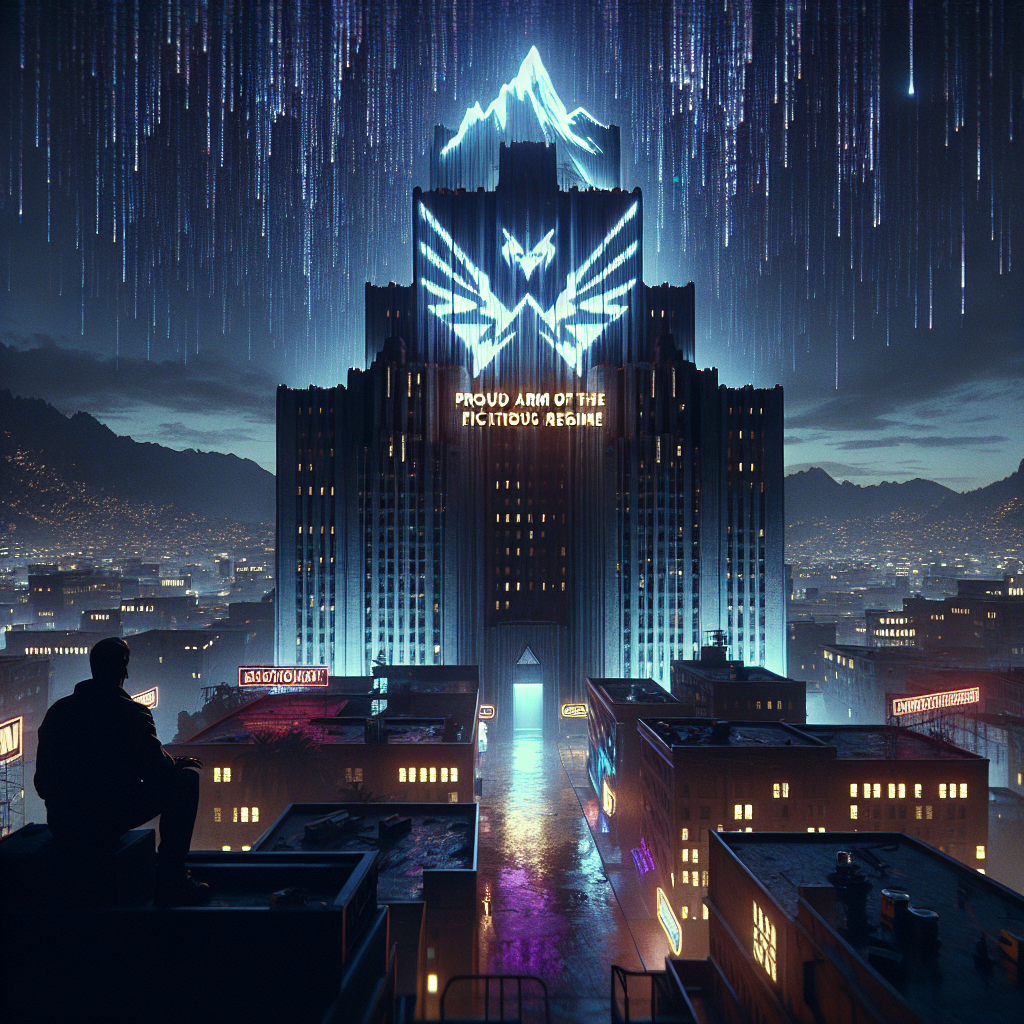
A bio turns brutal
For a few surreal minutes, one of Hollywood’s most powerful studios described itself in five loaded words.
On X, the platform once known as Twitter, the official Paramount Pictures account — with millions of followers and a century of brand equity behind it — suddenly carried a new bio: “Proud arm of the fascist regime.”[1][2]
No announcement. No context. Just a flat, venomous line sitting under the blue check, as if it had always been there.[1][2]
Then, almost as quickly as it appeared, it vanished. The profile snapped back to its usual corporate language: “The official X account for Paramount Pictures.”[1][2] But screenshots were already circulating, articles were being drafted, and an uncomfortable question was spreading faster than any studio press release:
Was this just a prank — or a political warning fired straight into the heart of an unprecedented media takeover battle?
The backdrop: A hostile bid and a streaming cold war
To understand why five words on a social media bio mattered, you have to zoom out to the bigger story: a bitter, high‑stakes fight over the future of entertainment.
Just days before the hack, Paramount Skydance CEO David Ellison had launched a hostile takeover bid for Warner Bros. Discovery (WBD), directly challenging a massive deal Netflix was already pursuing.[1][2] Hostile, in this context, simply means Ellison went around WBD’s leadership and took his richer, more aggressive offer straight to shareholders.
- Netflix had already struck an agreement to acquire HBO, Max, and related studios in a landmark deal.[2]
- Ellison responded with an all‑cash bid, valuing WBD at over \$100 billion, and framing Paramount’s offer as “a more certain and quicker path to completion.”[2]
Paramount’s financing reportedly involved heavyweight sovereign funds from Saudi Arabia, Abu Dhabi, and Qatar, adding a geopolitical layer that made regulators and rival studios twitchy.[2]
In this atmosphere — where every executive quote was examined, every move spun as existential — Paramount’s X bio suddenly calling itself part of a “fascist regime” felt less like a random insult and more like a diagnosis.
What likely happened behind the screen
Paramount has not publicly detailed the technical mechanics of the breach, only acknowledging that the account was briefly hacked before being restored.[1][2]
Cybersecurity analysts contacted by major outlets, however, paint a familiar picture:
- The most probable route was account credential compromise — someone getting hold of the username and password, or access tokens, via phishing or reused passwords.
- Less likely, but more alarming, would be a platform‑side vulnerability at X itself, where attackers exploit flaws in the service to jump directly into high‑profile accounts.
“People imagine cinematic hacks with code raining down the screen,” says fictional cybersecurity analyst Mara Chen, a former consultant to major studios. “In reality, most social media compromises come down to someone clicking the wrong link at 11 p.m. or using the same password on three services.”
Once inside, the attacker didn’t push malware, spam crypto, or post chaotic memes. They made one extremely specific edit: a short, politically loaded label aimed directly at Paramount’s perceived relationship to power and politics.[1][2]
That precision is what bothers experts the most. This wasn’t about easy money. It was about framing.
The accusation inside the hack
Why “fascist regime”?
In the days surrounding the hack, commentary had already turned toxic. Coverage highlighted concerns that Ellison’s bid, and Netflix’s competing offer, were entangled with political access and regulatory pressure, especially around then‑President Donald Trump’s role and relationships.[1]
Reports recounted how:
- Trump had suggested a mega‑merger like Netflix–WBD could be a “problem” for the market and might require intervention.[1]
- Ellison, the son of billionaire Larry Ellison, was perceived as having a “Trump card” through his personal connections and pro‑Trump reputation.[1]
- Top media leaders, including Netflix co‑CEO Ted Sarandos, were making quiet visits and calls that looked less like movie business and more like statecraft.[1][2]
In that climate, calling Paramount a “proud arm of the fascist regime” reads like a pointed accusation: that studios are not merely entertainment companies, but political instruments orbiting around power.
One glitch, one family, and a moment of doubt
In a quiet apartment three time zones away, Lena, a 32‑year‑old video editor and lifelong movie obsessive, noticed the story in her feed between coffee sips.
Paramount was her childhood. VHS tapes. Saturday mornings. Fraying posters.
She opened the screenshot, the words “Proud arm of the fascist regime” harsh under the iconic logo, and felt a jolt of something she couldn’t quite name — betrayal mixed with recognition.
“I know it was ‘just a hack,’” she later told a friend, “but it’s like somebody said out loud what we always kind of suspected — that these companies don’t just entertain us, they shape what we’re allowed to see, what’s normal, what’s acceptable.”
For most people, the incident passed in hours. But for others like Lena, it added to a slowly growing unease: If our culture is controlled by a handful of companies, and those companies are dancing with governments and billionaires, who is culture really for?
Industry: Shrug in public, scramble in private
Publicly, studios and streamers treated the incident as a footnote. The bio was fixed, journalists were told the account had been restored, and no extended post‑mortem emerged from Paramount.[1][2]
Behind closed doors, however, media companies quietly escalated their controls:
- Mandatory two‑factor authentication for social accounts.
- Tighter access lists — fewer people with direct posting privileges.
- Internal drills on phishing — fake messages designed to trick employees into surrendering passwords.
Government regulators, already circling the Netflix and Paramount–WBD deals, took note as well.
“This hack may be minor on its face,” says fictional Federal Trade Commission advisor Elijah Brooks, “but it underscores that these aren’t just any brands. They’re the information gatekeepers for hundreds of millions of people. When their channels can be hijacked in seconds, the risk isn’t just embarrassment — it’s influence at scale.”
Could a single hacked bio sway a billion‑dollar deal?
Probably not directly. Shareholders still look at projected earnings, synergies, debt loads, and the alphabet of regulatory agencies that might block or bless a merger.
But perception matters. In a bidding war where Netflix downplays Ellison’s bid as “expected” and insists it is “super confident” in its deal,[2] any moment that paints a rival as politically toxic, ethically compromised, or operationally sloppy becomes part of the narrative battlefield.
The hack didn’t change spreadsheets. It changed vibes — and in a media ecosystem addicted to outrage, vibes often determine which story the world tells itself about who should win.
What’s next — and could it happen again?
As long as high‑value brands live on platforms they do not own and cannot fully control, yes, this will happen again.
The incentives are too strong:
- Activists see a hijacked account as a perfect flash‑bang to expose or embarrass a powerful institution.
- State‑aligned actors see it as a low‑cost way to inject doubt, division, or propaganda.
- Individual hackers see prestige — and clout — in defacing a household name.
Paramount’s brief, brutal rebranding as a “proud arm of the fascist regime” will fade from the news cycle, but it leaves us with a sharp, unresolved tension:
If a studio’s identity can be rewritten in seconds by someone with the right password, how much of what we see from any powerful institution online is stable reality — and how much is just whoever got there first?
FAQ
Why was Paramount’s X account hacked?
The exact attacker has not been identified, but experts say it was likely a simple credential compromise — someone gaining access to the studio’s social media login and changing the bio to make a political statement.[1][2]
What did the Paramount X hack say?
The hacked bio briefly described Paramount Pictures as a “Proud arm of the fascist regime,” a loaded phrase interpreted as criticism of perceived political and corporate power around the studio and its takeover efforts.[1][2]
How does this relate to the Paramount–Warner Bros. Discovery takeover bid?
The hack came days after David Ellison’s Paramount Skydance launched a hostile, all‑cash bid for Warner Bros. Discovery, directly challenging Netflix’s existing agreement and intensifying scrutiny of the studio’s political and financial ties.[1][2]
Was user data or streaming content affected by the Paramount X account hack?
There is no public evidence that user data, streaming services, or internal systems were impacted; the incident appears confined to the X account’s profile bio, which was quickly restored.[1][2]
What are companies doing to prevent social media account hacks?
Studios and other large brands increasingly rely on two‑factor authentication, strict access controls, and regular phishing training to reduce the risk of social media account takeovers and reputational damage.
Could a hacked corporate social media account affect stock prices or mergers?
While a single hacked bio is unlikely to fundamentally alter a major merger, it can fuel negative sentiment, shape media narratives, and contribute to broader concerns among regulators, investors, and the public about a company’s security and ethics.