
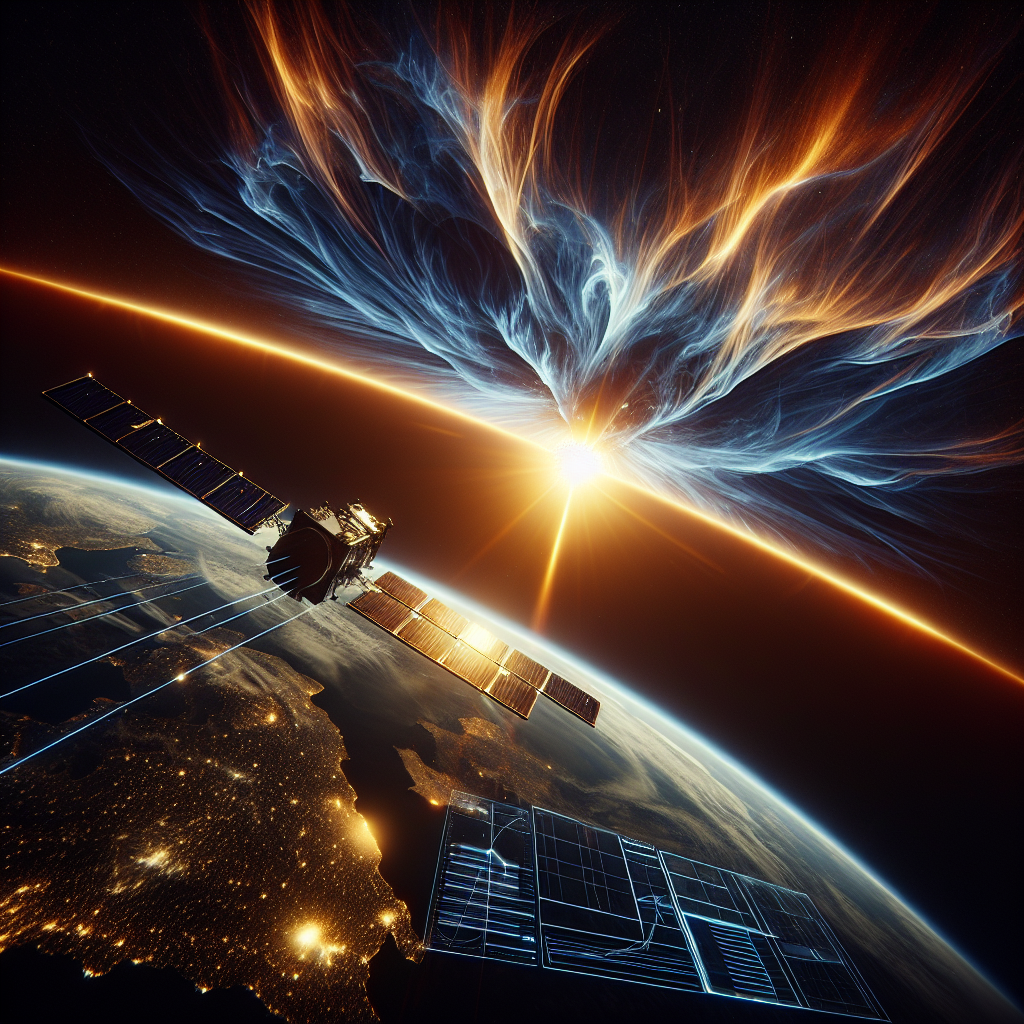
The call came at 3:47 AM. A satellite operator in Virginia jolted awake, staring at the red alert flashing across her screen. A massive solar flare was building on the Sun’s surface — the kind that could knock out GPS systems, cripple power grids, and leave millions in the dark. But this time, something was different. She had two hours to prepare.
That edge — those precious 120 minutes — came from Surya, NASA’s groundbreaking artificial intelligence model that just learned to predict the Sun’s most violent outbursts before they happen[1].
When the Sky Became a Weapon
For decades, solar flares have been the invisible threat haunting our technology-dependent civilization. These massive eruptions hurl radiation and charged particles toward Earth at speeds exceeding a million miles per hour. The consequences aren’t abstract: in 1989, a geomagnetic storm plunged six million Canadians into darkness for nine hours. In 2022, a solar event destroyed 40 SpaceX satellites worth over $50 million in a single day[1].
Our infrastructure hangs by a thread thinner than most realize. Passenger jets flying polar routes lose radio contact during solar storms, exposing crew and passengers to radiation levels equivalent to multiple chest X-rays[1]. Astronauts planning missions to Mars need precise warnings to survive — a direct hit from a solar particle event in deep space could be lethal[1].
Until now, forecasting these events felt like predicting earthquakes: we knew they’d happen, just never exactly when.
The Machine That Learned to Read Fire
Surya — named after the Hindu sun deity — represents something fundamentally new in space weather prediction. Developed through a partnership between NASA and IBM, this AI model consumed 14 years of continuous solar observations from NASA’s Solar Dynamics Observatory, which has photographed the Sun every 12 seconds since 2010[1].
The breakthrough lies in what computer scientists call a “foundation model” — an AI architecture that learns patterns directly from raw data without needing humans to label every image. Think of it as teaching a child to recognize faces not by explaining what eyes and noses are, but by showing them thousands of family photos until they intuitively understand what makes each person unique[1].
Surya’s visual predictions extend two hours into the future, outperforming existing forecasting methods by 15%[1]. That might sound modest, but in operational terms, it’s revolutionary. Two hours means satellite operators can reorient spacecraft to minimize damage. Power companies can redistribute loads to prevent cascade failures. Airlines can reroute flights away from radiation exposure.
Dr. Kevin Murphy, NASA’s chief science data officer, frames it plainly: “We’re making it easier to analyze the complexities of the Sun’s behavior with unprecedented speed and precision”[1].
Why This Moment Matters More Than You Think
The timing couldn’t be more critical. Earth’s orbit is becoming crowded with satellites delivering everything from GPS navigation to global internet access. As solar activity intensifies during its natural 11-year cycle, it heats Earth’s upper atmosphere like turning up a burner under a pot. That heated atmosphere creates drag, pulling satellites downward, forcing premature reentry[1].
Consider Maria, a fictional logistics coordinator in Seattle who relies on GPS to route 200 delivery trucks daily. A single solar storm causing GPS errors of just a few meters could turn her entire operation into chaos — delayed shipments, missed deliveries, angry customers. With Surya’s predictions, her company receives advance warning. Routes get recalculated. Contingency plans activate. The storm passes, and nobody even notices.
This human dimension — the invisible infrastructure keeping modern life functioning — is what makes space weather forecasting so vital. “Our society is built on technologies that are highly susceptible to space weather,” explains Joseph Westlake, director of NASA’s Heliophysics Division[1].
The Democratization of Solar Defense
Perhaps most remarkably, NASA released Surya as open-source software. The complete model lives on HuggingFace, with training code available on GitHub[1]. Any researcher, student, or developer worldwide can download it, experiment with it, and build applications NASA never imagined.
This generosity serves a strategic purpose. By lowering barriers to participation, NASA hopes to spark innovations across scientific domains. The same AI architecture could analyze planetary atmospheres, track Earth’s climate patterns, or process data from future Mars missions[1].
Meanwhile, parallel efforts are expanding. Penn State researchers received $1.23 million from NASA to accelerate weather forecasting using satellite data and computer vision[2]. Tomorrow.io launched a constellation of CubeSats capable of atmospheric monitoring every 40 minutes[4]. NASA selected Planette to develop QubitCast, a quantum-inspired system extending predictions up to one year ahead[3].
What Happens When AI Sees What We Can’t
The deeper implications ripple outward. Surya proves that AI can find patterns in natural phenomena too complex for human analysis — patterns hiding in petabytes of imagery that would take lifetimes to examine manually. If this approach works for solar physics, what other mysteries might foundation models unlock?
But questions linger. As we entrust critical infrastructure decisions to AI predictions, how do we verify accuracy when the stakes involve millions of lives? What happens when the model encounters solar behavior outside its training data — events so rare they didn’t appear in 14 years of observations?
Could our growing dependence on AI-predicted space weather create a dangerous blind spot the next time the Sun does something we’ve never seen before?
FAQ
What is NASA’s Surya AI model and how does it predict solar flares?
Surya is an artificial intelligence foundation model trained on 14 years of Solar Dynamics Observatory data that generates visual predictions of solar flares two hours into the future, helping protect satellites and power grids from space weather.
How does solar flare prediction with AI improve space weather forecasting?
AI-powered solar flare forecasting analyzes vast datasets to detect subtle patterns humans miss, providing advance warnings that let satellite operators, airlines, and power companies take protective measures before solar storms strike.
Why is solar storm prediction important for modern technology?
Solar storms can disable GPS systems, damage satellites, disrupt communications, trigger power grid failures, and expose astronauts and airline passengers to dangerous radiation levels, making accurate forecasting critical for infrastructure protection.
Can anyone use NASA’s solar weather AI model?
Yes, Surya is completely open-source, available on HuggingFace with code on GitHub, allowing researchers, educators, and developers worldwide to use and build applications with the model.
How accurate is AI at predicting space weather events?
Surya’s preliminary results show it outperforms existing solar flare forecasting benchmarks by 15%, marking significant progress in operational space weather prediction capabilities.