
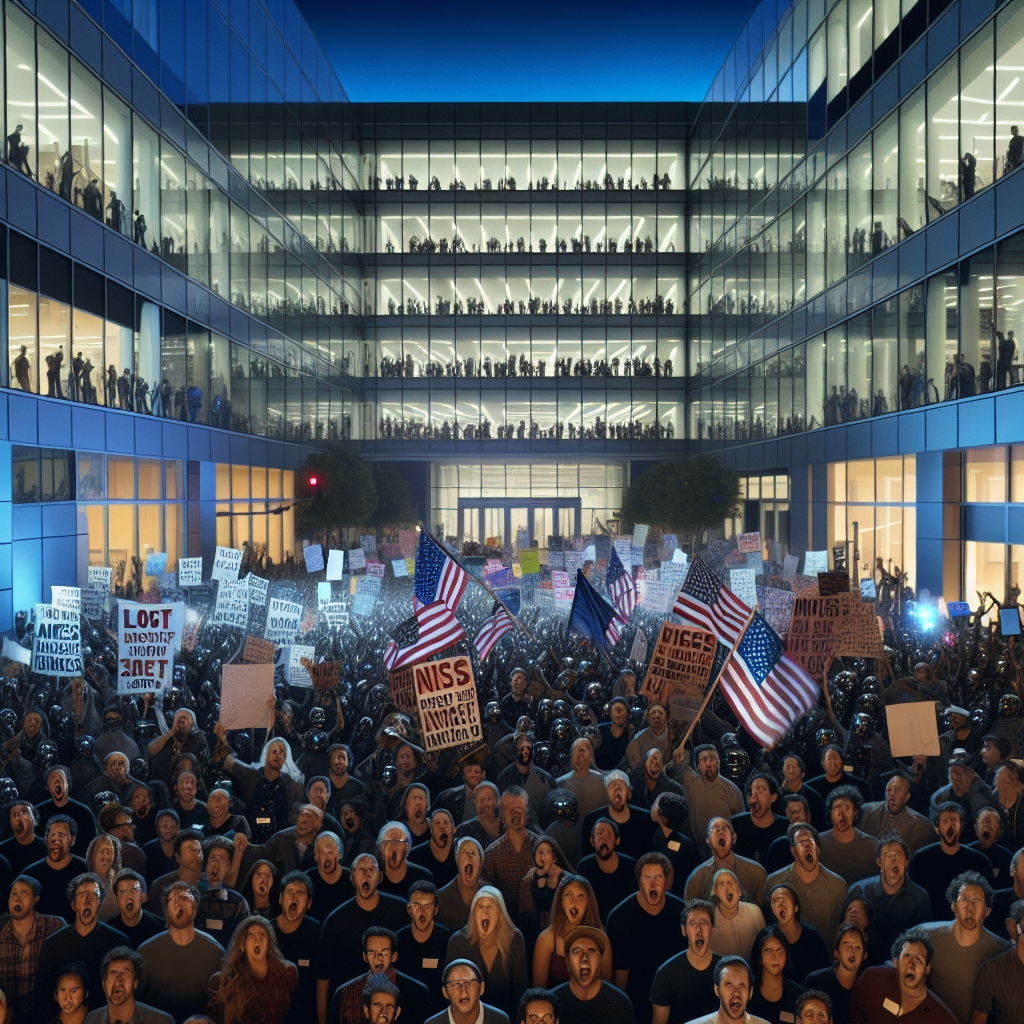
An Evening in Middle America, 2025
The sun had just slipped below the grain elevators of Defiance, Ohio, casting amber reflections across the old storefront windows. Inside the Fenton family kitchen, a familiar voice crackled from the TV: “They want to silence you. They want to control your every move online. Are we going to let them?” Ann Fenton, a retired schoolteacher, watched as her son angrily scrolled his phone. On his feed, images of torch-lit rallies. Under his thumbs, frantic posts declaring a new “holy war”—not between nations or religions, but between millions of disillusioned Americans and the titans of Silicon Valley.
How Did We Get Here? The Birth of a Digital Revolt
The flashpoint came quietly, as many digital explosions do. After moderators at a leading tech platform banned a series of incendiary populist accounts, millions from the MAGA movement—Donald Trump’s enduring core of cultural warriors—declared a “holy war” against Big Tech.
Posts and calls to action blazed across Reddit, X, and Truth Social. Digital anger spilled into the streets, merging with a broader populist fury already simmering in the American heartland.
The underlying grievances ran far deeper than any one ban or algorithm tweak. Years of economic anxiety, automation-induced job losses, and culture clash had left entire swathes of the population desperate for status, visibility, and control[5]. Now, in the eyes of millions, Silicon Valley’s unseen grip on newsfeeds and digital town squares was the last straw[2].
Populism Meets Platform Power: Clash of the Century
What makes this MAGA-fueled tech backlash so volatile is the clash of two mighty forces:
- Populism, which in its latest incarnation blends distrust, cultural pride, and a hunger for control[1][5].
- Platform power, the invisible code and corporate policies that shape which voices boom and which are muted across the digital landscape.
When MAGA leaders dubbed their fight a “holy war,” it wasn’t just a rhetorical flourish. For many, this battle is as spiritual as it is political. It plays out in meme armies, coordinated campaigns to review-bomb app stores, and even real-world protests outside Google and Meta offices.
Why Does This Matter? More Than ‘Left vs. Right’
This isn’t just another left-right spat; it’s a showdown over who gets to set the terms of modern American life.
- MAGA activists argue Big Tech platforms have declared war on their values, throttling conservative voices and enforcing an elite, “globalist” worldview[4].
- Silicon Valley leaders, often at odds with MAGA policies, insist moderation policies are non-partisan, focused on reducing hate speech and disinformation.
Analysts like Emily Royce of the Center for Digital Democracy see the stakes this way: “We’re watching the birth of a new digital class war. Control over information is power—and right now, both MAGA and Big Tech believe the other side is hell-bent on taking it all.”
The Attack Vector: Weaponizing the Algorithm
The core battleground isn’t a voting booth or even a street corner—it’s the algorithm. These sophisticated, ever-shifting rules decide which posts spread, which opinions dominate, and who gets shadowbanned. For years, right-leaning users have claimed that “de-platforming”—suspending or outright banning high-profile accounts—amounts to digital censorship[4].
MAGA’s answer: platform flight (fleeing to alternative networks), coordinated campaigns to flag perceived “enemy” content, and legal challenges arguing for free speech rights within private companies’ domains.
An American Family in the Digital Trenches
Ann Fenton’s son, Tyler, is a digital native, glued to online communities where the tech backlash is gospel. He follows “citizen journalists” who promise to expose every Big Tech “plot.” Sometimes, the Fentons go days barely talking—one glued to Fox News, the other to subreddits calling for regulatory crackdowns on tech monopolies. Technology, once a tool for connection, is now the frontline of a culture war that’s invaded their living room.
Government, Industry, and Ripple Effects
The backlash drew quick attention in Washington.
- Congressional populists held hearings grilling tech CEOs over perceived censorship.
- State attorneys general filed lawsuits framing moderation as viewpoint discrimination.
- Rival tech companies poured money into alt-platform startups promising “free speech” utopias, sparking a mini-boom in anti-Big Tech investing.
Even some business leaders, long allied with Silicon Valley, sensed risk. “If platforms lose the trust of half the country, every advertiser and investor starts sweating,” warned tech analyst Rajesh Brar. Behind closed doors, engineers scrambled to tweak content policies while PR teams prepared for the next onslaught of negative headlines.
What’s Next? Could It Happen Again?
The digital holy war is far from over. As tech giants double down on algorithmic moderation, populist forces are hardening too—learning, adapting, and multiplying their tactics.
Will these skirmishes grind on for years, reshaping social media and public discourse? Or will a new “digital Bill of Rights”—maybe even government intervention—cool the flames?
In the end, one question pulses louder than any algorithm:
If control over the digital public square decides who gets to speak, who gets to listen, and who gets to win—what does democracy mean in the age of the algorithm?
FAQ
What is the “MAGA holy war against Big Tech?”
This refers to coordinated efforts by the MAGA movement to protest, boycott, or “fight back” against tech giants they accuse of censorship and suppression of conservative voices.
How did the MAGA movement clash with Silicon Valley?
Through online campaigns, legal action, and migration to alternative platforms, the movement challenged mainstream tech’s content moderation and corporate power.
What are ‘alt-tech’ platforms?
These are alternative social media sites (like Gab, Truth Social, and Rumble) that promise fewer restrictions and more “free speech,” often attracting banned or de-platformed users.
Why do MAGA activists distrust Big Tech?
Many believe companies like Google, Meta, and X manipulate algorithms or enforce rules that marginalize conservative or anti-establishment content.
What could this mean for the future of American democracy?
Ongoing battles over online speech may reshape the definition of digital rights, with new laws or platforms emerging in response to the culture war over Big Tech’s power.