
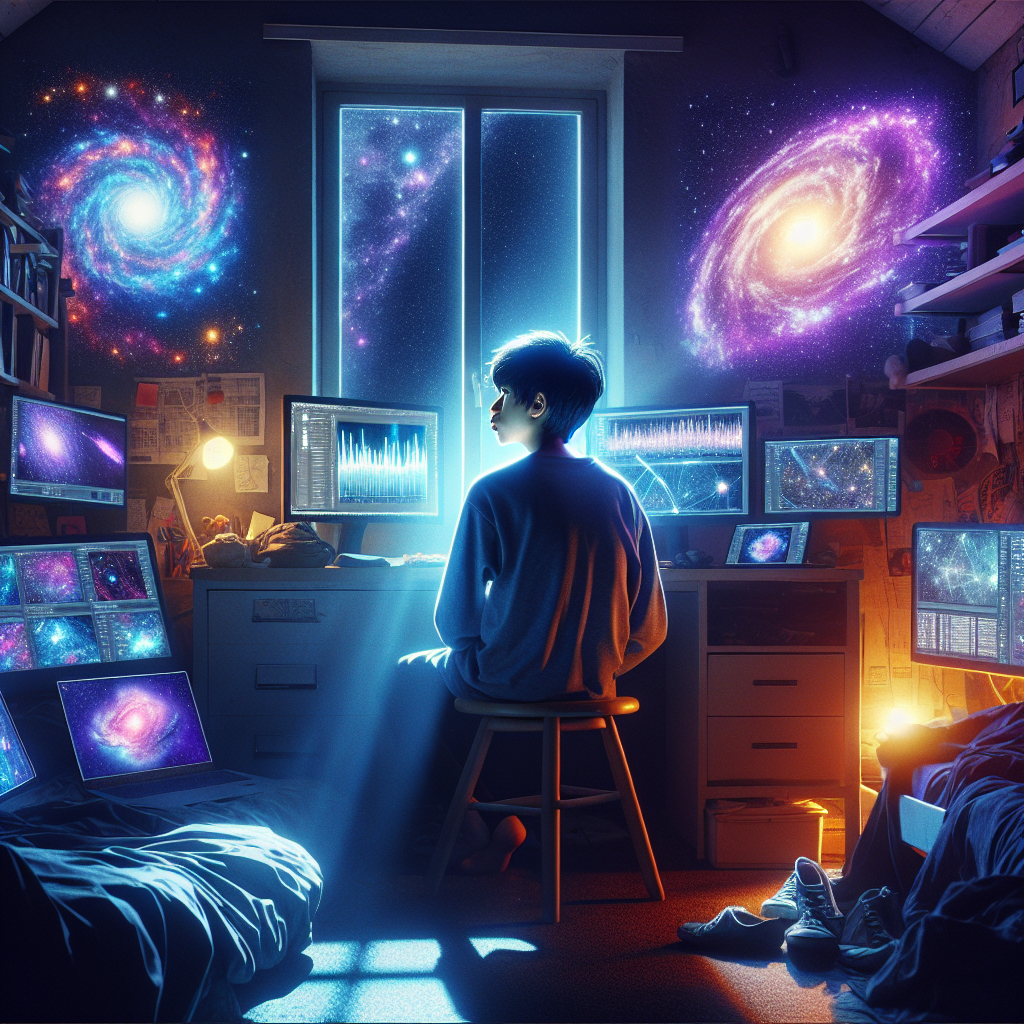
A Blink in the Dark: The Moment the Cosmos Shifted
The lights in Matteo Paz’s room flickered with the glow of two screens—one charting endless columns of numbers, the other an infrared map of the eternal night we call outer space. It was well past midnight in Southern California, the hour when most seventeen-year-olds sleep. Matteo wasn’t like most seventeen-year-olds. On this evening, a flash of irregular data points caught his eye—a subtle pattern that, for everyone else, had faded quietly into the background noise of the universe[1].
He leaned in, breath held, realizing the implications with heart-thumping certainty: he had uncovered something the world’s best astronomers had not. Minutes later, he triggered the algorithm he’d been fine-tuning for months—an advanced artificial intelligence, the kind usually found in multimillion-dollar research facilities, not a suburban bedroom. What followed was an astronomical revelation destined to challenge some of humanity’s longest-held beliefs[1].
The Spark: How Curiosity Triggered a Revolution
Matteo’s journey launched at Caltech’s Planet Finder Academy, a research boot camp for extraordinary high school students hosted by one of NASA’s most prestigious partners[1]. Despite being surrounded by aspiring astrophysicists, Matteo brought a distinctly outsider’s perspective—he was obsessed with both space and artificial intelligence. Under the mentorship of Davy Kirkpatrick from Caltech’s Infrared Processing and Analysis Center, Matteo became fixated on the hidden byways within NASA’s NEOWISE mission data—a massive trove meant to catalog near-Earth asteroids, but rumored to hold so much more[1].
Deploying his own AI model, Matteo sifted through endless terabytes of cosmic data with unprecedented speed and intuition. What he found was a series of objects—1.5 million, to be exact—that evaded the gaze of even the most advanced NASA algorithms. These were not your average asteroids. Some may be ancient binary stars waltzing in distant galaxies, others the flares of dying suns, or the rare, luminous signals of quasars[1].
What’s at Stake: Why This Discovery Matters
The implications are profound. NEOWISE’s colossal database was built to spot objects that threaten Earth, like asteroids and comets. Hidden within it, however, were flickers and anomalies—tiny variations in brightness, color, or motion—that had always been dismissed as statistical flukes or background noise[1]. Matteo’s AI swept away that noise and found the melody: proof that the database was, in reality, even richer than scientists dared hope.
In the words of Caltech’s Dr. Andrew Howard (who oversaw the program), “A find of this scale is seismic for astronomy—it tells us the universe is far, far busier and more chaotic than current models predict.” For everyday earthlings, this means new insights into the cosmic neighborhood, more comprehensive warnings about potential dangers, and—more romantically—the possibility of discovering celestial phenomena never before witnessed by human eyes.
AI in the Trenches: Breaking Down the Innovation
What precisely did Matteo build? Picture an algorithm—a series of digital instructions—programmed to mimic how humans spot patterns, but running at superhuman speed and scale. Traditional detection tools focus on known types of objects. Matteo’s AI, by contrast, had been trained to “expect the unexpected,” correlating faint clues across infrared wavelengths no one else had ever flagged as meaningful[1].
This AI didn’t just see what was already catalogued. It found new cosmic signatures by interpreting variance in brightness, time, and trajectory—revealing stars, galactic oddities, and perhaps even the scattered remnants of ancient cosmic collisions. In plain English: it’s like switching the universe from black-and-white to full technicolor.
Through Their Eyes: The Family Next Door
Consider the Washingtons, a family living just outside Los Angeles. For years, they gazed at the stars on clear, cool nights. After Matteo’s breakthrough made headlines, their youngest daughter turned to her family and said, “I wonder if that’s a new star, one of the ones they found.” Suddenly, cosmic discovery wasn’t abstract. It was tangible—something a neighbor or classmate could shape, and that, in turn, shapes the narrative of who gets to explore the skies.
From the White House to Mission Control: The World Responds
The reaction came swiftly. NASA lauded the discovery as “a testament to the power of fresh eyes and creative thinking.” Government space agencies everywhere began reaching out to high school partnerships, searching for the next quantum leap in space data analysis[1]. Silicon Valley investors, sensing seismic societal shifts, poured funding into STEM education and young AI developers.
The U.S. Department of Defense, not to be outdone, acknowledged in a rare joint statement that “civilian innovation is now central to national security in the era of space exploration”—a tacit admission that, in the hands of teens like Matteo, artificial intelligence could protect us all from cosmic hazards humanity has yet to imagine.
What’s Next: Could It Happen Again?
Could another teenager, half a world away, discover the next unseen force in our universe? The answer is a resounding yes. As AI grows cheaper, faster, and smarter, and as space data becomes the property not just of governments but curious students everywhere, the boundaries of what we can find, map, and understand will only speed further past the horizon.
The only real question is: Who will be next to shatter the darkness?
FAQ
Who is Matteo Paz and what did he discover?
Matteo Paz is a California high school student who used an AI model to discover 1.5 million previously hidden space objects in NASA’s NEOWISE data.
What is NEOWISE and why is it important?
NEOWISE is a NASA mission that surveys the sky in infrared to detect asteroids, comets, and other cosmic bodies. The dataset is a goldmine for astronomical research.
How does artificial intelligence help find new space objects?
AI quickly detects patterns and anomalies lost in vast data, uncovering objects traditional methods overlook.
What are the broader impacts of these discoveries?
Newly mapped objects improve our understanding of cosmic evolution, planetary risks, and might lead to entirely new branches of astronomy.
Could ordinary people get involved in space discovery?
Yes, as data tools and AI become more accessible, students and citizen scientists can make significant contributions—sometimes world-changing.