
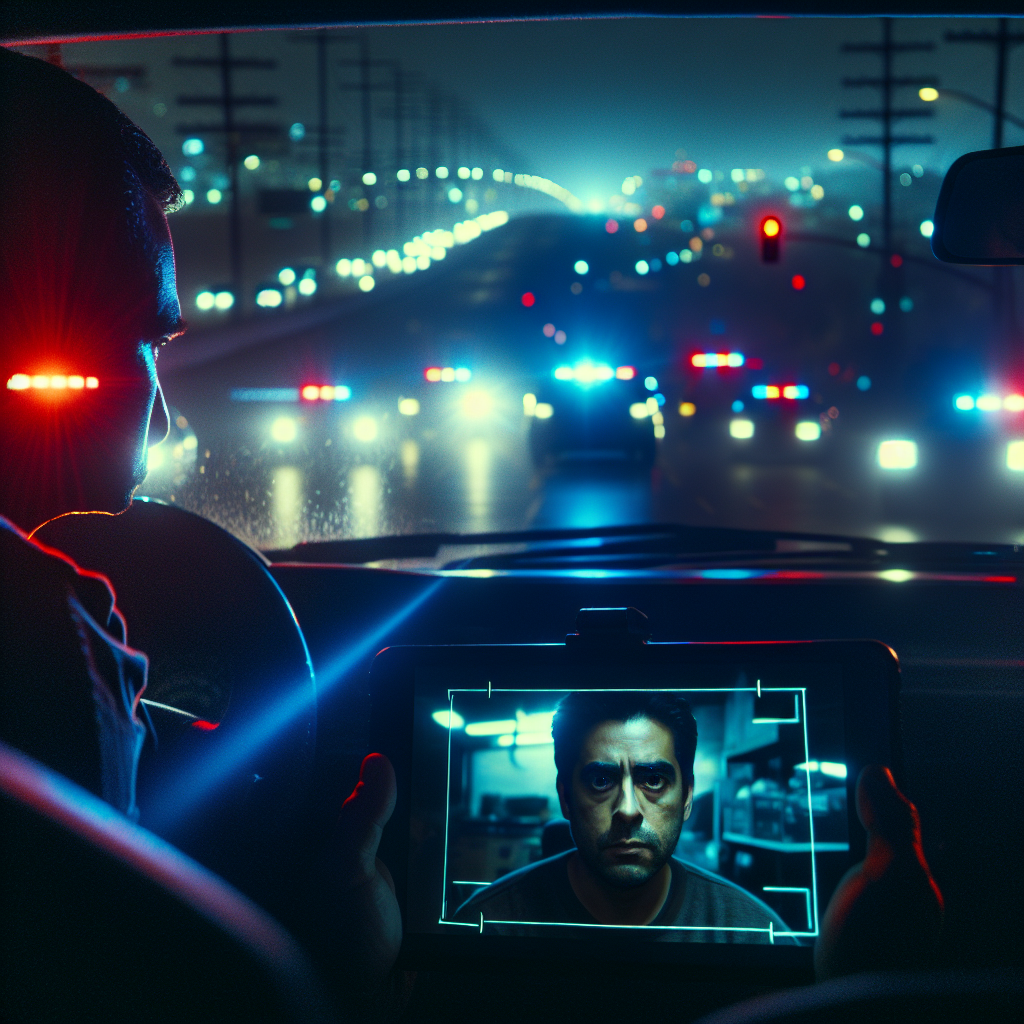
The phone camera hovers inches from his face.
A federal agent, vest stamped with bold white letters, tilts the device, framing the shot.
“Look straight ahead,” the officer says.
The shutter clicks.
Somewhere in a government data center, his image is hurled against a vast, invisible wall of faces — more than 200 million photos, pulled from U.S. government databases.[2]
The man is Luis Gutiérrez, a U.S. citizen.[2]
And in this moment, on an ordinary American street, his citizenship is no longer defined by his birth certificate… but by what a secretive facial recognition app says he is.
The App in Their Pockets
The tool is called Mobile Fortify, a smartphone app built by U.S. Customs and Border Protection (CBP) and deployed by Immigration and Customs Enforcement (ICE).[2][4]
To the public, it looks like a simple camera. To federal agents, it is a handheld portal into some of the most sensitive databases the U.S. government controls.
After an agent snaps a photo, Mobile Fortify runs that face against a massive image trove stitched together from multiple federal systems — including an FBI database and checks for outstanding state warrants, according to internal materials reviewed by reporters at 404 Media and Reveal.[2]
The result screen can show a name, date of birth, immigration “alien number,” and whether the person has an order of deportation.[2]
In other words: a real-time immigration status check, powered by your face.
A System Built for Borders — Turned Inward
The technology behind Mobile Fortify was originally tuned for borders and airports.
CBP has long used face comparison at ports of entry to verify that a traveler matches their passport photo.[2]
But internal Department of Homeland Security (DHS) documents show something more troubling: Mobile Fortify is now being used inside the country, on American streets, on people simply going about their lives.[2]
The app “turns the system usually used for verifying travelers at the border inward against people on U.S. streets,” Reveal reports.[2]
One DHS document even concedes the obvious risk:
“It is conceivable that a photo taken by an agent using the Mobile Fortify mobile application could be that of someone other than an alien, including U.S. citizens or lawful permanent residents.”[2]
That is not a hypothetical. That is what happened to Gutiérrez.[2]
When the App Beats the Birth Certificate
Members of Congress briefed on the program say the app’s results are treated not just as helpful data — but as final truth.
Rep. Bennie Thompson, ranking member of the House Homeland Security Committee, says ICE officials told him that an apparent match from Mobile Fortify is considered a “definitive” determination of a person’s status.[2]
According to Thompson, officers have been told they may ignore evidence of American citizenship, even a birth certificate, if the app labels someone an “alien.”[2]
Civil liberties lawyers call that unprecedented.[1][3]
Advocacy groups point out that no other U.S. law enforcement agency is known to allow facial recognition to be used as a final determination of identity or legal status; even TSA and CBP typically verify with government-issued documents when something looks off.[1]
“ICE does not allow people to opt-out of being scanned,” notes the Electronic Frontier Foundation, “and ICE agents apparently have the discretion to use a facial recognition match as a definitive determination of a person’s immigration status… even in the face of contrary evidence.”[3]
A Country Where Any Face Can Be Scanned
The videos are grainy, but the pattern is clear.
In one clip that appears to be from Chicago, a Border Patrol officer stops two young men on bicycles.[2][4]
When one says he has no ID, an agent turns to a colleague:
“Can you do facial?”[2][4]
The second officer lifts his phone, lines up the boy’s face, holds it there for a few seconds, and checks the screen.[2][4]
The boy is then asked to confirm his name.[4]
In another video, ICE officers surround a car. The man inside insists he is a U.S. citizen.[2]
“Alright, we just got to verify that,” an officer replies, pointing the phone camera at him.
“If you could take your hat off, it would be a lot quicker… I’m going to run your information.”[2]
None of this looks like a border crossing.
It looks like everyday life in America.
A Fictional Day, Built from Real Powers
Imagine this:
You’re on your way to your kid’s soccer game. You forgot your wallet on the kitchen counter. A joint ICE–local task force has set up a “routine” checkpoint on the road. An agent flags you over.
“You got ID?”
You pat your pockets. Nothing.
The officer sighs, then raises his phone.
“Look right here for a second.”
Your face is captured.
The app spins. Somewhere, deep inside that 200-million-image network, your data is cross-checked against prior encounters — a tourist trip, a past traffic stop, an old visa from a study-abroad semester you barely remember.[2]
Now imagine the system glitches. A bad match. Your name looks like someone else’s. A database entry is wrong.
The app flashes back a profile with an “alien number” and a prior deportation order — belonging to a different person who looks just enough like you in one low-res file.
ICE’s current practice, according to lawmakers and rights groups, allows an officer to treat that biometric hit as authoritative, even if you swear you’re a citizen and later produce documents.[1][2][3]
For most people, that’s not a Netflix thriller.
That’s a nightmare with handcuffs.
Pushback: Senators, Lawyers, and a Growing Alarm
The quiet spread of Mobile Fortify did not stay quiet for long.
A coalition of digital rights, immigrant justice, and civil liberties organizations has demanded DHS and ICE immediately halt field use of the app.[1][3]
Their warning is blunt: using face scans as definitive proof will “undoubtedly lead to wrongful detentions, deportations, or worse.”[1][3]
In the Senate, lawmakers like Ed Markey and Adam Schiff have pressed ICE for answers, citing social media videos as “clear evidence that ICE has not only developed advanced biometric technology but is actively using it to surveil and identify members of the public.”[4]
They argue that this “expanded use of [facial recognition] creates serious privacy and civil liberties risks” and have demanded policy details, audit logs, and limits.[4]
The ACLU’s Jake Wessler puts it more simply:
“In the United States, we should be free to go about our business without government agents scanning our faces… and putting us at risk of misidentifications and wrongful detentions. ICE and CBP’s use of Mobile Fortify on the streets of America should end immediately.”[2]
How DHS Responds — and What It Won’t Say
DHS officials have largely refused to speak plainly about Mobile Fortify.
DHS Assistant Secretary Tricia McLaughlin has said only that “DHS is not going to confirm or deny law enforcement capabilities or methods.”[2]
CBP, which built the app, has confirmed it exists and that it was developed “for ICE agents and officers” to “help field personnel gather information during immigration inspections.”[2]
The agency insists that agents “must consider all circumstances before deciding on someone’s immigration status,” and says further details cannot be shared due to “law enforcement sensitivities.”[2]
Yet internal letters and public reporting tell a different story: on the ground, Mobile Fortify is often treated as a yes/no machine for human status.[1][2][3][4]
What’s Next — and Could It Happen Again?
The core question now facing the U.S. is not technical.
It is profoundly political:
Do we accept a future where your face becomes a roaming ID card, checked anytime, anywhere, by a government phone — even when you are a citizen, even when the system is wrong?
Senators are pushing for guardrails. Rights groups want a full stop. ICE, so far, is not backing down. And the databases behind Mobile Fortify only grow larger with every border crossing, every mugshot, every government photo session imported into the system.[1][2][6]
The story that began with one U.S. citizen scanned on the street is really about infrastructure: once a country builds a nationwide biometric dragnet, it rarely dismantles it. It just finds new ways to use it.
So as Mobile Fortify quietly expands from the border to the block, the real suspense is left with us:
If an app in an agent’s hand can overrule your papers and your own testimony, what does “citizen” even mean — and who gets to decide?
FAQ
Q1: What is ICE’s Mobile Fortify facial recognition app?
Mobile Fortify is a law enforcement smartphone app used by ICE and some CBP personnel to scan a person’s face and match it against a massive set of U.S. government image databases, returning identity and immigration information in the field.[2][4]
Q2: How does Mobile Fortify’s facial recognition technology work in practice?
An agent takes a photo; the app compares it to a database of around 200 million images, pulling from systems run by CBP, the FBI, and state warrant records, then displays potential matches along with status details like deportation orders.[2]
Q3: Can Mobile Fortify scan U.S. citizens or only non-citizens?
Yes, DHS documents acknowledge that the app can and does scan U.S. citizens and lawful permanent residents, not just undocumented immigrants.[2]
Q4: Why are privacy and civil liberties groups alarmed about ICE facial recognition use?
Groups argue that Mobile Fortify enables warrantless face surveillance, provides no opt-out, and allows officers to treat a face match as definitive proof of immigration status, risking misidentification, wrongful detention, and deportation.[1][3]
Q5: What are lawmakers proposing to do about ICE’s Mobile Fortify program?
Members of Congress have demanded that ICE halt or strictly limit the app, disclose policies, log usage, and ensure facial recognition is never the sole basis for deportation or detention decisions.[1][4][6]
Q6: Could Mobile Fortify misidentify someone because of facial recognition errors?
Yes. Facial recognition systems are known to produce false matches, especially across race and age lines, and critics warn that tying immigration enforcement directly to these tools magnifies the harm of every error.[1][3][6]
Q7: How can ordinary people protect themselves from ICE facial recognition checks?
Currently there is no reliable way to opt out of being scanned in public; advocates instead push for legal reforms, transparency, and strict limits or moratoriums on ICE and CBP’s facial recognition surveillance.[1][3][5]