
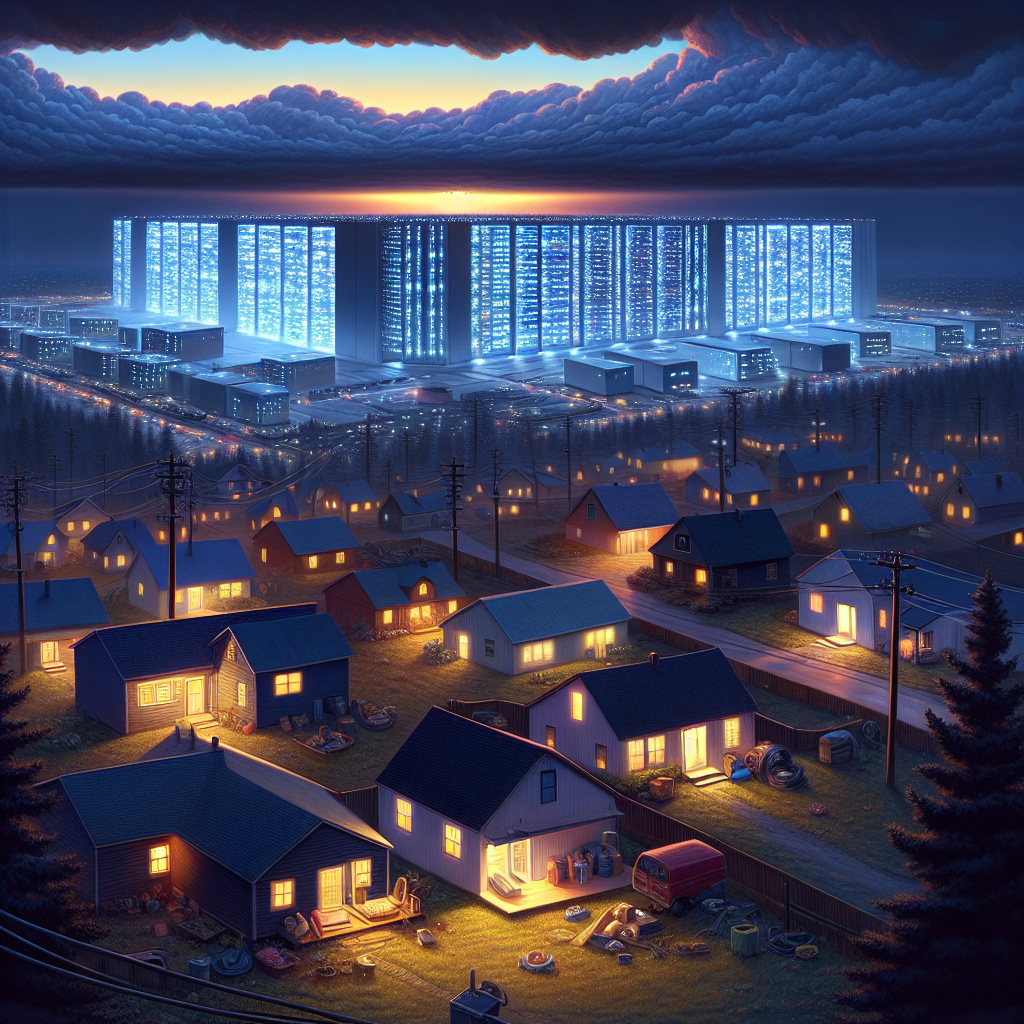
A siren in the dark
On a sweltering August night in a small Ohio town, the power went out.
Not from a storm. Not from a downed line.
From demand.
In the glow of her phone’s flashlight, Maria, a single mom working two jobs, listened to the local news: the grid was strained again, as utilities scrambled to feed a new, insatiable neighbor on the edge of town — a vast, windowless data center complex, humming day and night to power AI, cloud computing, and streaming for the world.
Her grocery bill was up. Her rent was up. Now her electric bill was up too.
The one thing that wasn’t up? Her paycheck.
Maria isn’t a statistic. She’s a stand‑in for millions of Americans now living on the front lines of Big Tech’s next land grab: the race for energy‑hungry data centers, funded in part by the very people struggling to keep the lights on.[2]
The new gold rush isn’t online — it’s on the grid
Over the past few years, Big Tech’s biggest players — cloud, AI, crypto, and social media giants — have quietly shifted from competing for your attention to competing for something more primitive: electricity.
AI models need colossal computing power. Streaming video runs 24/7. Bitcoin mining rigs chew through energy like a perpetual furnace.[2] To feed this, companies are building or leasing sprawling data centers across the country — many of them in places where working‑class families already live one bill away from crisis.[3]
Here’s the catch:
Those data centers aren’t just plugged in and billed like everyone else.
Utilities and state regulators often offer them discounted industrial rates, tax breaks, and infrastructure upgrades — costs that don’t vanish. They get spread across everyone else’s bills. In other words, when a trillion‑dollar company gets a deal, your monthly statement quietly makes up the difference.[2][3]
How the invisible subsidy works
Strip away the acronyms and it’s simple:
- A tech giant wants to build a massive data center.
- The local utility sees a huge new customer — and future profits.
- To lure the project, the utility offers special rates, new substations, upgraded transmission lines, and long‑term power contracts.
- Those investments are mostly paid for by ratepayers — regular people and small businesses — through higher bills over time.[2]
This is a form of cross‑subsidy: big users get a bargain; everyone else fills the gap.
And it’s landing in an economy where:
- Working‑class Americans are already skipping medical care and medications to afford essentials.[3]
- Over a third of Americans were late paying a bill in the last year, with even higher rates among non‑college, working‑class households.[3]
- Many are turning to “Buy Now, Pay Later” and payday loans just to cover groceries, rent, and child care.[3]
So when utilities quietly shift costs to households in the name of “economic development,” they’re not just pencil‑pushing. They’re weaponizing the power bill against the people least able to pay it.[3]
“We’re being asked to underwrite their future”
Energy lawyer and consumer advocate “Dr. Lena Patel” puts it bluntly:
“Big Tech generated hundreds of billions in operating cash last year. They can afford their energy. Instead, we’re socializing their infrastructure and privatizing their profits. Working‑class families are being asked to underwrite Silicon Valley’s future.”[4][3]
Her point isn’t theoretical. The top four tech firms alone produced $451 billion in operating cash flow in 2024, more than enough to fund their own infrastructure many times over.[4]
Yet when they scout new sites, they often choose states with weak oversight, energy surpluses on paper, or regulators eager to declare victory on ‘jobs’ — even if many of those jobs are temporary construction roles, not long‑term careers.[2]
Maria’s bill, Big Tech’s bargain
Back in Ohio, Maria opens her latest bill:
Another increase. A new line item. A utility “adjustment.”
Her local utility has just committed billions to new grid investments to serve a cluster of new data and crypto facilities. Publicly, it calls this “modernization” and “economic development.” Privately, as one fictionalized energy analyst describes it:
“This is a one‑way bet. The utility gets guaranteed revenue from ultra‑large customers. Regulators allow them to recover costs from everyone else. The risk is socialized. The upside is not.”
For families like Maria’s, this means:
- Higher electric bills in an already brutal affordability crisis.[3]
- More exposure to outages as systems run closer to their limits.
- Fewer public dollars available for schools, transit, and healthcare when states pile on tax breaks to woo data centers.[2][3]
The benefits — stock price bumps, AI product launches, new corporate campuses — accrue elsewhere, to people who will never see the line item that made them possible.
The political fuse is lit
Americans are not blind to this imbalance.
A recent survey found overwhelming, cross‑class support for reining in corporate power — from banning corporate money in politics to breaking up monopolies, including Big Tech firms.[3]
When communities find out that their bills are rising to subsidize companies already worth hundreds of billions, they react fast:
- Local coalitions in multiple states have begun pushing “no sweetheart deals for data centers” ordinances.
- Consumer advocates are demanding full transparency on who pays for new substations, power contracts, and grid expansions.
- Some public utilities are being pressed to adopt “growth must pay for itself” rules — forcing data centers to shoulder the real cost of their arrival.
Government regulators are now caught between two visions of the future:
- One where America becomes the world’s data engine, at almost any public cost.
- Another where digital growth is allowed only if it doesn’t cannibalize basic affordability and reliability for the people already living there.
What’s next — and could it happen again?
The story is still being written. AI investments, crypto mines, and hyperscale data centers are only accelerating. Global funding for AI infrastructure and cybersecurity is surging, as investors chase the next wave of digital gold.[1]
That means the pressure on the grid — and on your bill — is not going away.
Three pivotal questions will decide what happens next:
- Will regulators force Big Tech to pay the true cost of its power addiction?
- Will communities demand veto power over projects that raise local bills without delivering real, lasting benefits?
- Will we treat electricity as a public lifeline — or just another input for the world’s largest corporations?
The next time you open your electric bill and feel that familiar jolt of anxiety, ask yourself:
Are you paying for your own lights — or for someone else’s cloud?
FAQ
Q1: What does “cash‑strapped Americans shouldn’t fund Big Tech’s data centers” really mean?
It means households already struggling to afford basics are indirectly paying for data center infrastructure through higher electric bills and subsidies, while wealthy tech companies receive discounted power, tax breaks, and public support.[2][3]
Q2: How do Big Tech data centers affect my utility bills?
When utilities invest in new lines, substations, or capacity to serve massive data centers, those costs are often spread across all customers — so your bill can rise even if your own usage doesn’t.[2]
Q3: Are there any real economic benefits for local communities?
Data centers can bring construction jobs and some long‑term positions, but critics argue the jobs‑per‑dollar of subsidy are low, and that tax breaks and higher bills can outweigh local gains, especially for working‑class residents.[2][3]
Q4: Can regulators stop cash‑strapped customers from subsidizing Big Tech?
Yes. State utility commissions can require cost transparency, ban special rate deals that shift costs to households, and enforce “growth pays for growth” rules so large users cover their own infrastructure needs.
Q5: How does this tie into AI, Bitcoin, and cloud computing demand?
AI training, Bitcoin mining, and hyperscale cloud platforms need huge amounts of always‑on computing power, which translates into enormous and growing electricity demand — making data centers a major driver of new grid investments.
Q6: What can consumers do if they oppose subsidizing Big Tech’s energy use?
They can participate in public utility hearings, support consumer advocacy groups, pressure local officials to oppose costly subsidy deals, and push for legislation that protects residential ratepayers from cross‑subsidizing corporate energy use.