
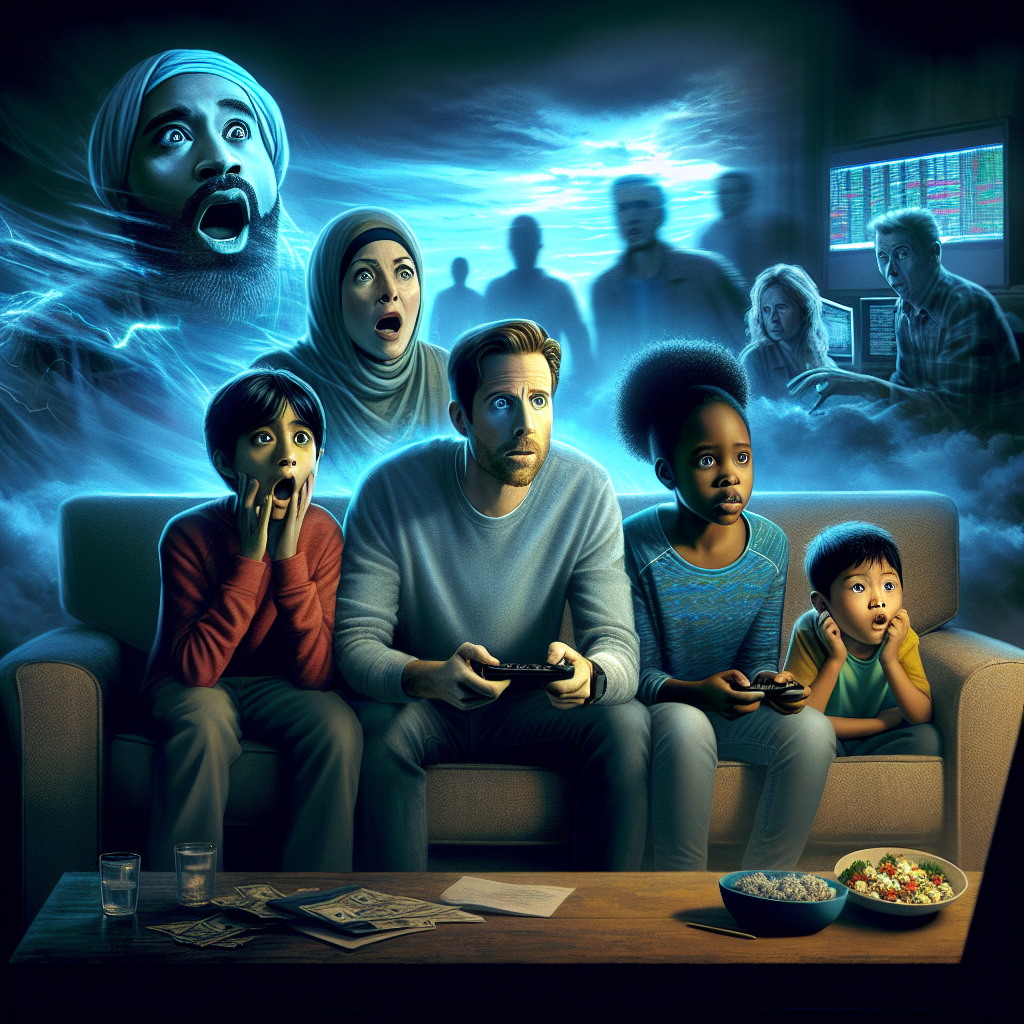
The Night TV Went Dark — And Wall Street Blinked
It’s just after 11:30 p.m., and living rooms nationwide are aglow with anticipation. Jimmy Kimmel’s late-night wisecracks are as much a part of America’s bedtime ritual as the warm hum of the refrigerator. Suddenly, silence. The screen fades; the monologue is gone. Overnight, ABC—one of television’s most iconic voices—goes dark, sparking outrage on social media and, by sunrise, panic on the stock market floor.
What began as a terse press release about “ill-timed remarks” erupted into a national spectacle: viewers waving cancelations, celebrities denouncing censorship, Wall Street watching Disney’s market value tumble by nearly $5 billion in a single week[5].
Why did a single program’s suspension provoke such chaos across the tech, financial, and cultural landscape? And is the future of broadcast television more precarious than we ever realized?
Walt Disney’s Precarious Balancing Act
In boardrooms perched high above Burbank and Silicon Valley, Disney executives weigh an impossible equation: Maintaining trust with advertisers, soothing regulatory nerves, and placating a hyper-polarized audience—all while their fortunes rest increasingly on streaming empires, not over-the-air signals.
ABC justified their suspension of Kimmel as an act of caution, hoping to tamp down outrage and avoid inflaming national divisions. But this logic was greeted with skepticism from industry experts. “It was a reactive move that underestimated both the audience’s maturity and the costs of silencing a voice at the center of national conversations,” said Professor Susan Campbell, media analyst[5].
The financial fallout was immediate: Disney’s stock plummeted, viewers canceled subscriptions in protest, and unions representing over 400,000 workers rallied behind Kimmel, warning of a chilling effect on free expression across media[5].
Streaming’s Meteoric Rise — And Broadcast’s Slow Eclipse
As the dust settled, sharp-eyed industry analysts saw a story much bigger than late-night TV. On Wall Street, the smart money scrutinized the very value of legacy networks. Laura Martin, a senior analyst at Needham, delivered a bombshell theory: perhaps Disney should not just sell ABC, but shut it down altogether, taking the loss up front to accelerate their digital transition[3].
Her argument was stunning: ABC, she calculated, now represents less than 5% of Disney’s market cap. By shuttering the broadcast network, Disney could unlock new value and shed regulatory shackles, freeing itself to pivot nimbly in the era of generative AI and streaming on-demand services[3].
Without FCC regulations—which only apply to broadcast—Disney could simulcast content on Hulu, its streaming arm, instantly, making ABC obsolete and diminishing Washington’s grip on its media empire[3].
How All the Pieces Connect: Technology, Regulation, and the Human Factor
To understand Disney’s high-stakes chessboard, follow the technology. Behind the scenes, Disney has committed vast resources to cloud infrastructure, relying on Amazon Web Services (AWS) to power Disney+ across the globe[1]. Their arsenal now includes real-time data engines, AI content curation, and “clean room” data-sharing tech—making Disney’s digital arm not just a competitor to broadcast, but a disruptor[1][2].
At the personal level, picture Mia—an ordinary viewer who gathers nightly with her family, sharing laughs at Kimmel’s jibes. Suddenly, she’s cut off, feeling voiceless. She cancels her Disney+ subscription in frustration, voice trembling as she explains to her children, “We all deserve to laugh and sometimes, to disagree. But when someone’s voice is taken away, we all feel a bit smaller.”
This heartbreak played out at scale: millions of viewers, caught in a wider tug-of-war between political climate, free speech, big tech, and media conglomerates.
The Fallout — And the Response
Tech and entertainment circles exploded in protest. Hollywood’s unions put their considerable weight behind creative freedom, warning of lasting damage if TV executives cave to every spike in political pressure[5]. Meanwhile, corporate strategists quietly doubled down on streaming, eyeing the fortress-like safety of cloud platforms away from the FCC’s reach.
Analyst Tom Lenard mused, only half-joking, about “putting the spectrum on the open market”—a direct shot at just how outmoded legacy broadcast might be in 2025[3].
And as Disney scrambled to restore order—returning Kimmel to the air—many wondered if the chaos was merely a tremor before the big quake: the irreversible migration from TV towers to tech clouds, from regulated spectrums to borderless, on-demand streams[5].
What’s Next: Could It Happen Again?
The aftershocks are poised to roll. If turbulent politics or a viral soundbite can shutter late-night TV, what’s to stop a future where all of network television’s influence vanishes, one controversial moment at a time?
Media leaders are betting big on streaming technology, less vulnerable to regulatory whim or advertiser boycott[1][2][3]. Yet, as AI-woven content, algorithmic curation, and cloud platforms redefine our shared media experience, society must ask: Are we trading one set of gatekeepers for another—this time, governed by code, data, and market algorithms?
So, as the broadcast era flickers and the streaming revolution ascends, whose voices will fill our living rooms next—and who decides which will be heard, or silenced? Join the debate below.
FAQ
What happened between Disney, ABC, and Jimmy Kimmel?
Jimmy Kimmel’s show on ABC was abruptly suspended after controversial remarks, triggering national backlash, a $5 billion loss in Disney’s stock value, and a heated debate over censorship and free speech[5].
How does cloud technology (AWS, Google Cloud) power Disney’s streaming transition?
Disney+ relies on platforms like AWS for everything from video delivery to real-time analytics, using AI and cloud data to create a seamless viewing experience[1][2]. This makes the transition away from traditional broadcast both faster and more flexible.
Why are analysts urging Disney to shut down ABC?
Some analysts argue that ABC represents a shrinking share of Disney’s business and carries heavy regulatory baggage. Shutting down the network could unlock billions in shareholder value and free Disney to focus on unregulated, rapid-growth streaming services[3][4].
How did viewers and Hollywood respond to the ABC controversy?
Audiences protested by canceling subscriptions, while Hollywood unions and celebrities rallied against what they saw as political censorship. The backlash signaled the high cultural stakes of broadcast decisions[5].
What are the long-term effects for broadcast TV and streaming?
This episode may hasten the decline of network TV, pushing major players like Disney further into digital and cloud-powered models, where they face fewer regulations and can respond quickly to viewer demand[3][4].